






























The design brief for a battery pack intended for a modern hybrid hypercar is increasingly mirroring the specifications found in Formula 1 energy storage rather than conventional road-car batteries. This shift is driven by the demands for very high instantaneous power, tightly bounded stored energy, and repeated high-power duty cycles, all while adhering to severe volumetric and mass constraints. While technologies like 800V architectures and high-power motor-generators are already present in road cars, the manner in which they are specified, packaged, and thermally managed for this class of vehicle directly draws from race-car practice.
Technical Details of the Hypercar Battery
When MAHLE Powertrain was tasked with designing and manufacturing a high-performance 800V battery for a limited-run hybrid hypercar, the requirements presented a specific set of parameters. These included a hybrid system capable of producing up to 600 hp (450 kW), possessing 4.1 kWh (~15 MJ) of usable energy, utilizing an 800V architecture, and operating under a duty cycle akin to repeated qualifying laps rather than a typical customer drive cycle.
This project, completed at MAHLE Powertrain’s Northampton facility, represents the latest turn-key battery project featuring both an 800V architecture and immersion cooling. It signifies a convergence point where motorsport battery practices and road-car battery practices have become closely aligned, allowing design tools, cell arrangements, and thermal strategies to transfer almost directly between the two domains.
The engineering approach moved away from modifying a passenger-EV baseline. Instead, the pack was engineered from a clean sheet, starting with a motorsport battery cell and packaging it for a road-legal application, due to the sustained high-rate discharge requirements coupled with significant mass, volume, and thermal constraints.
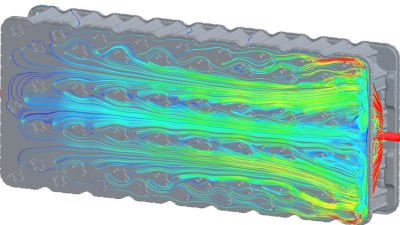
The underlying engineering incorporates specialist vehicle performance analysis, electro-thermal and structural simulation, and 3D fluid-flow analysis. These tools were used to optimize the internal structure and coolant flow around the battery cells, ensuring an even temperature profile across the pack even during peak discharge. This methodology draws heavily on thermo-mechanical analysis previously developed for optimizing cylinder head structures and cooling passages in modern engine development.
MAHLE Powertrain also conducts detailed cell characterization in-house, supplementing data from the cell supplier. This provides the 1D thermal models with the necessary accurate cell characteristic data. By executing full multi-physics simulation early in the design cycle, the team was able to iterate the cooling architecture in software before moving to the test rig, with the analysis output directly informing the design of the immersion cooling flow regime within the modules.
Intended Performance Impact and Thermal Strategy
The thermal strategy employed is the most distinguishing feature of this pack compared to prior MAHLE Powertrain work and most current road-going high-performance battery packs. Instead of using a conventional cold-plate arrangement, the cells are placed in direct contact with a dielectric fluid. This setup provides full-surface thermal contact, which is essential for achieving very high rates of heat rejection.
The thermal behavior was meticulously engineered using CFD techniques, paying close attention to the thermal interaction between the conductors and the cells. Since heat is generated within both the cells and the electrical conductors, the relative temperature of each component dictates the overall heat flow. Simulations were run to examine the module’s thermal performance under demanding load cases. The CFD analysis provided insights into both the current flow across the entire battery electrical system and the heat flow. Furthermore, examining the current density within the tab-to-busbar connection and conductors allowed for detailed optimization of the conductor design to improve performance, reduce weight, cost, and complexity.
The technical justification for using immersion cooling in a high-discharge pack is that direct contact with a dielectric fluid allows for a more uniform temperature gradient to be achieved across the cells. Every design choice related to the immersion architecture required in-house qualification, resulting in a pack capable of sustaining the discharge profile demanded by the application.
Competitive Context and Design Framework
The 2026 Formula 1 power-unit regulations provide a useful benchmark for understanding what “F1-grade” signifies today. The MGU-K’s maximum deployment power is capped at 350 kW (469 hp), which is roughly triple the current-generation figure, while the total usable energy stored in the battery at any time is capped at 4 MJ. This combination of high instantaneous power and tightly bounded stored energy presents a different engineering challenge than designing a long-range EV battery, and it closely resembles the needs of a modern hybrid hypercar during peak deployment.
The pack itself is constructed with three modules, each containing 128 cells, arranged in a 64S2P layout, yielding an overall 192S2P architecture to achieve the 800V system voltage. While every component is tailored for the hypercar’s tight installation, the underlying architecture is designed for reconfiguration. The cell type, module count, and geometry can all be adjusted without requiring a complete re-engineering of the pack. This means the framework can be applied to other high-performance vehicle programs, including future hybrid hypercars, small-series electric performance cars, and adjacent uses like eVTOL propulsion, where the combination of high-power density and short duty cycle is relevant.
Mike Bassett, engineering director at MAHLE Powertrain, noted that this modularity is the point where a bespoke motorsport-grade project transforms into a repeatable engineering capability. “The hypercar program delivered a pack. More importantly, it delivered a design framework, a simulation toolchain, and a validated immersion-cooling approach that can be carried forward to the next program,” he stated.
Season Implications for the Wider Industry
Immersion cooling was, until recently, a technology of laboratory scale within the mainstream EV sector—a technology awaiting the right combination of ultra-fast-charging demand, cell chemistry, and coolant chemistry to justify moving away from cold-plate systems. Those conditions are now beginning to materialize. Increasingly, high-density stationary storage, aerospace-grade propulsion, and ultra-fast-charging road-car applications are converging on the same thermal architecture that motorsport has been refining over the last decade. The Formula 1-grade hypercar battery serves as a demonstrator for this convergence, requiring engineering that is inherently portable to the next generation of high-performance road vehicles.
What to Watch Next
The convergence demonstrated by this hypercar battery suggests that the industry is moving toward standardized, high-density thermal management solutions. As these technologies mature, the focus will shift to how quickly and affordably these motorsport-derived frameworks can be integrated into mass-market applications.
Considering this trend, how quickly can the lessons learned from motorsport’s extreme duty cycles be translated into reliable, cost-effective solutions for consumer electric vehicles?
