















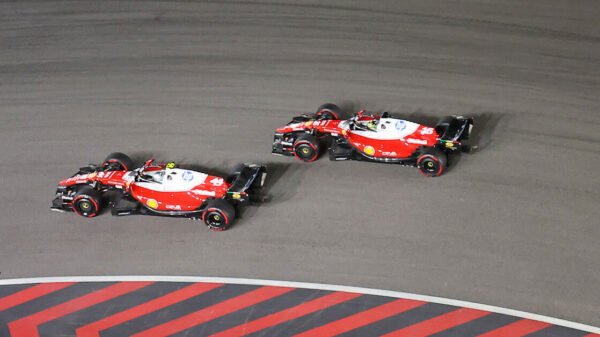
















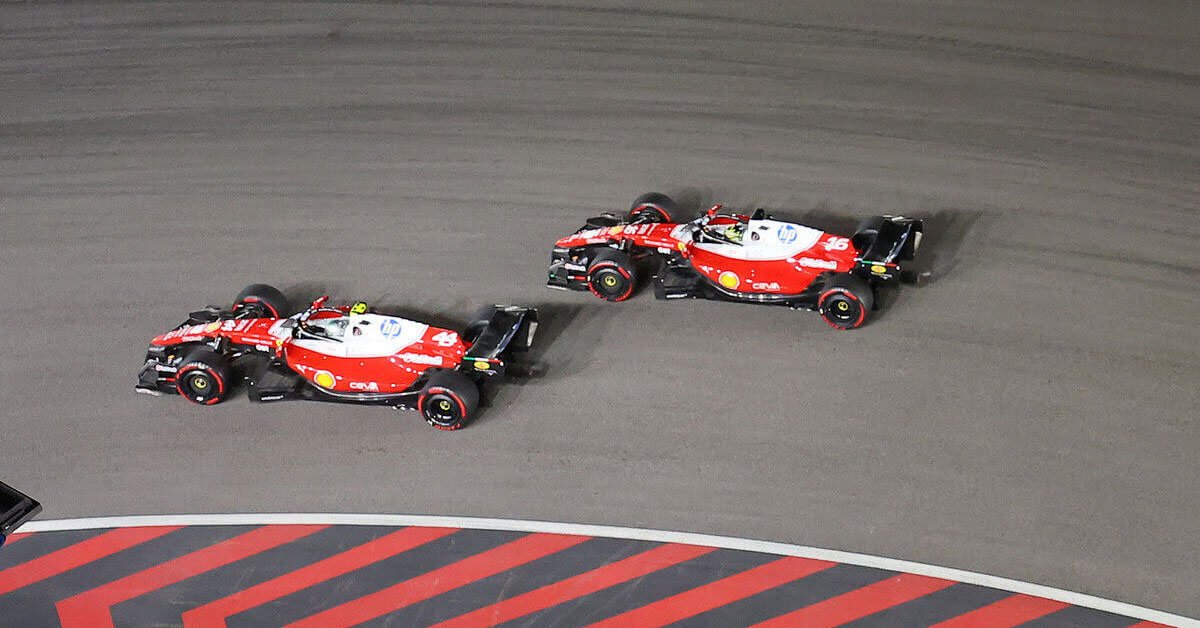
A 10-second penalty was issued to Charles Leclerc following his collision with Lewis Hamilton at the 2026 Formula 1 Las Vegas Grand Prix. The decision centered on an overtaking attempt during the race on lap 38. A detailed 3D reconstruction of the Ferrari incident was used to justify the stewards’ ruling, which highlighted a paradox within the current FIA overtaking guidelines.
Steward Ruling and Driving Standards Guidelines
The penalty imposed on the Monegasque driver was deemed correct in light of the Driving Standards Guidelines agreed between the drivers and the FIA. These guidelines, which are shared criteria for assessing driver behaviour, specify a precise reference point for an overtaking attempt on the inside: “at the apex of the corner, the front wheel of the attacking car must reach at least the level of the mirror of the car on the outside.”
In the 3D reconstruction of the Ferrari incident, Charles Leclerc’s front wheel was estimated to be approximately 35 centimetres behind Lewis Hamilton’s mirror, illustrating a failure to meet this essential requirement of the Driving Standards Guidelines.
Incident Context: Leclerc and Hamilton
The circumstances leading to the collision began at the previous corner when Lewis Hamilton attempted to overtake Oscar Piastri without successfully completing the manoeuvre, leaving the British driver running slightly wide on the entry to Turn 7. Charles Leclerc then spotted an opening and attempted to move down the inside. However, the available space disappeared before the number 16 Ferrari could establish sufficient overlap.
When Charles Leclerc realised the situation, he attempted to abandon the manoeuvre by braking firmly, tightening his line towards the left, and climbing onto the kerb to avoid contact. By this point, he was trapped, lacking the necessary space or time to escape. The right-front wheel of the number 16 Ferrari made contact with the left-rear wheel of Lewis Hamilton’s car, causing the British driver to spin.
The incident appeared to be an overtaking attempt that unexpectedly resulted in a situation with no possible escape route, rather than a deliberate assertion of the right to the corner.
Immediate Impact and Paradox
The penalty directly impacted the race result for Charles Leclerc. The comparison between this incident and another at the same corner on lap 12—involving Lewis Hamilton and Lando Norris—reveals a contradiction in the current framework. In the Norris incident, Lando Norris managed to advance considerably further, with his front wheel estimated to be approximately 54 centimetres beyond the reference point established by Lewis Hamilton’s mirror. Lewis Hamilton received a 10-second penalty in that instance after widening his trajectory to avoid contact.
This comparison demonstrates that the current framework can reward more aggressive overtaking attempts over comparatively cautious manoeuvres.
Team and Driver Procedural Response
The FIA’s explanation for Lewis Hamilton’s 10-second penalty in the earlier incident provided context for that decision. Lewis Hamilton complained over the team radio, with some justification, that he had effectively been punished for avoiding an accident.
The guidelines were designed to prevent drivers from inserting their nose on the inside without establishing sufficient overlap, which can easily trigger contact in open-wheel racing.
What Happens Next
The penalty imposed on Charles Leclerc reflected the fundamental principle of the guidelines, which prevent a minimal degree of overlap from automatically granting entitlement to racing room through a corner. The guidelines are intended to prevent situations where very little contact is required to eliminate an opponent from the race.
The source does not detail an appeal window for the penalty issued to Charles Leclerc.
Given the differing outcomes in the two incidents, how should the FIA balance rewarding aggressive overtaking with preventing contact?
