































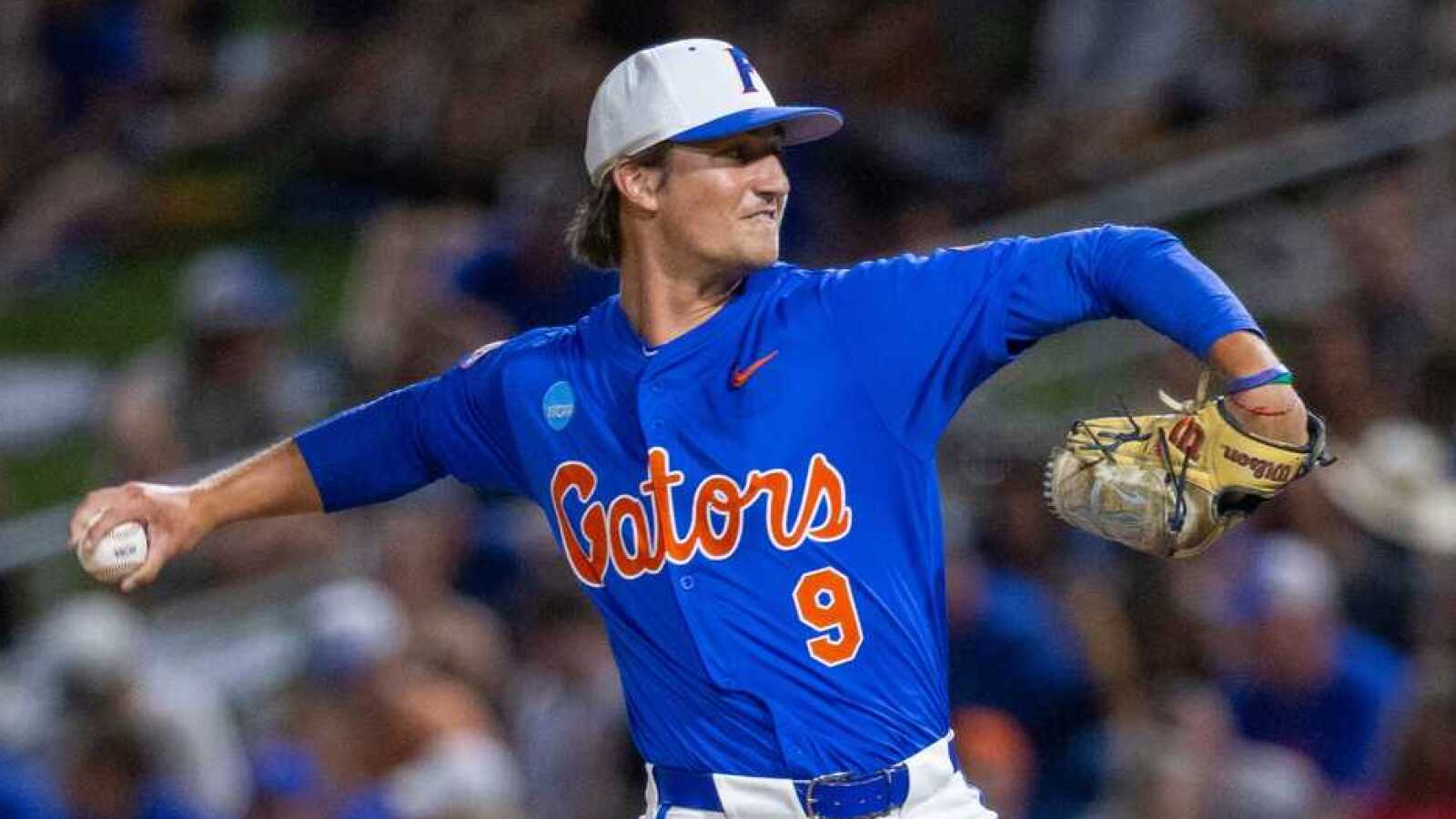

Florida’s Luke McNeillie.
USA TODAY Network via Reuters Connect
In the middle rounds of the MLB Draft, when most selections reward present polish, the sharpest value often belongs to arms whose raw tools exceed their current results.
With the No. 152 overall pick in the fifth round of the 2026 MLB Draft, the New York Mets selected Luke McNeillie, a right-handed flamethrower out of the University of Florida.
McNeillie’s fastball already touches 99 mph while pairing it with a slider showing plus traits.
The club is not drafting a finished product. New York is drafting the opportunity to develop one.
— MLB Draft (@MLBDraft) July 12, 2026
What drew Mets to Luke McNeillie?
In 34 innings across 18 appearances and three starts last season, the flame-throwing right hander struck out 48 batters while walking 17, producing a 12.7 strikeout-per-nine rate and a 2.82 strikeout-to-walk-ratio on his way to a 3.97 ERA. This is a notable improvement from his 7.07 ERA as a freshman and 4.82 as a sophomore. His slider is his most consistent secondary weapon likely to produce swing-and-miss results in pro ball.
What kept McNeillie available until the fifth round was legitimate and persistent questions. He worked almost exclusively in relief for the Gators, logging just 122 career innings over three seasons, with his final-year workload further curtailed by injury management. Command has been uneven, tied to an inconsistent arm slot and release point which limits his extension and deception. The changeup remains underdeveloped, leaving him without a reliable third pitch. Projecting him as a starter therefore carries real uncertainty, and other clubs correctly identified the same constraints.
For the Mets, these constraints are manageable variables, not fixed barriers. They have invested in pitching development, analytics and biomechanics to improve release-point repeatability, fastball shape stability, changeup viability and the ability to sustain pitches. Since the acquisition cost was low, New York can test McNeillie as a starter or reliever without all variables needing to succeed. Even a return to shorter-relief roles could still result in a useful major league arm if the fastball-slider combination remains strong. There are multiple development paths available.
With the No. 152 pick, the Mets are not purchasing certainty. They are drafting the right to find out what 99 mph, a sharp slider and a sophisticated development system could look like all together. The risks of inconsistent command, limited workload history, and an incomplete pitch arsenal are genuine. Yet, the modest cost and several viable routes to contribution create an asymmetry in favor of the selection.
Josh Davis is a sports journalist and editor covering MLB, NFL, NBA, college football, and college basketball. He is a proud graduate of the University of Georgia’s Grady School of Journalism and Mass Communication. Davis currently serves as an Associate Editor at ClutchPoints and is the founder of OutOfSightSports.
More must-reads: