

































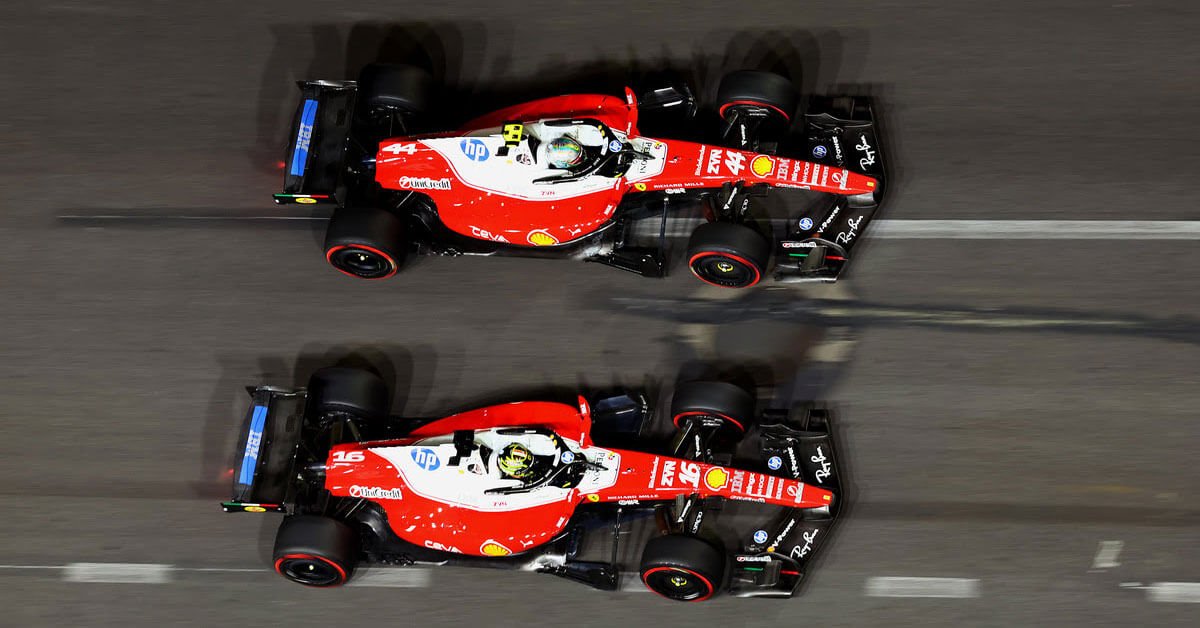
The recent penalty handed to Charles Leclerc following a collision with Lewis Hamilton at the 2026 Las Vegas Grand Prix has prompted a detailed technical review. The stewards’ decision, resulting in a 10-second penalty for Leclerc, was not based on a subjective assessment of space but on a precise interpretation of Formula 1’s driving standards guidelines. This incident highlights the stringent criteria required for an overtaking maneuver to be deemed legitimate, and understanding the telemetry and racing lines involved is crucial to grasping the technical basis of the ruling.
Technical Details of the Incident
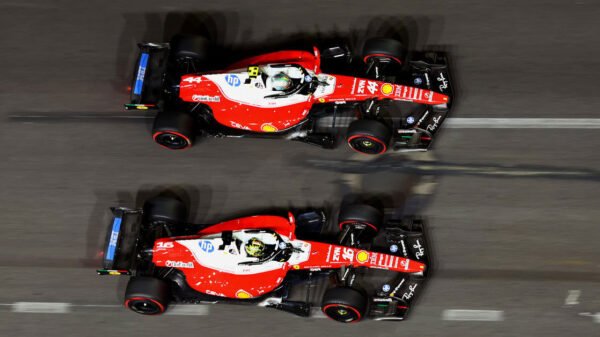
The core of the stewards’ decision rested on a specific technical failing during the overtaking attempt at Turn 7. According to the official reasoning, at the apex of the corner, the front axle of Charles Leclerc’s Ferrari (number 16) did not achieve the required overlap—specifically, it was not at least alongside Lewis Hamilton’s mirror on his Ferrari (number 44). This failure meant that Leclerc had not “earned the right to the corner” under the established criteria for inside overtaking maneuvers.
Telemetry analysis provided further insight into the differing approaches of the two drivers. In the data, Leclerc (represented by the red trace) was observed to remain on the throttle for a longer duration and began lifting off significantly later than Hamilton (white trace). The data indicated a difference of approximately 100 metres in this timing. While braking or lifting off later does not automatically validate an overtake, the telemetry showed Leclerc carrying considerably more speed into the corner entry. To successfully execute the maneuver, he needed to simultaneously reduce speed, maintain proximity to the inside line, and establish the necessary overlap before the apex—a final requirement that was not met.
Conversely, Hamilton’s approach showed an earlier lift-off but maintained some throttle input through the corner, suggesting he was managing his trajectory through the corner rather than initiating an aggressive closing maneuver.
Intended Performance Impact
The technical analysis points to a critical interplay between speed management and corner geometry. Leclerc’s initial high entry speed created the overtaking opportunity, but this speed demanded a more aggressive deceleration profile. When attempting to keep the trajectory extremely tight toward the kerb while simultaneously braking deeply and requiring significant steering angle, the margin for error diminished substantially. The front tires were subjected to intense demands from both deceleration and lateral forces.
The attempt to ride the inside kerb further compressed the available space for precise trajectory control. As the car reached the apex, the number 16 car began drifting toward the outside of the corner. The issue, therefore, was less about the initial decision to attack and more about the physical capability to complete that attack within the available parameters without contact.
Competitive Context
The review of Lewis Hamilton’s onboard footage provided a key counterpoint to any notion of deliberate obstruction. The footage did not show Hamilton making a sudden, aggressive steering movement inward to squeeze Leclerc. Instead, Hamilton appeared to be following the general racing line set by the McLaren car ahead. The small steering corrections visible were consistent with a driver adapting to a car on the inside and managing the available space, rather than actively closing the door.
The FIA’s assessment, therefore, was not a judgment on who moved toward whom, but a strict application of regulatory criteria. Simply having the nose of the car on the inside was insufficient; the attacking driver had to establish the required overlap at the specified point while maintaining sufficient control to complete the maneuver.
Season Implications
This incident underscores the highly technical and unforgiving nature of modern F1 racing. For Ferrari, the event intensified scrutiny on team dynamics, particularly concerning the rivalry between Leclerc and Hamilton. From a development perspective, the analysis highlights that raw speed into a corner must be paired with flawless execution of the braking and rotation sequence to convert an advantage into a successful pass.
The focus remains on how teams allocate resources to refine these delicate overtaking sequences. The regulatory framework demands precision, meaning that even marginal failures in establishing the required overlap can lead to severe penalties, irrespective of the driver’s intent.
What to Watch Next
As the season progresses, the focus will remain on how teams manage high-speed overtaking zones. Upcoming races will serve as crucial tests for the interpretation of these driving standards. Furthermore, the ongoing data validation phase will continue to refine how the FIA interprets telemetry against on-track events, ensuring consistency in penalty applications.
Given the technical rigor applied here, how will teams adapt their race strategies to maximize overtaking opportunities while strictly adhering to the established overlap criteria?
