










Victor Wembanyama’s ultimate legacy will be defined by how he responds to this heartbreak

•
5 min read
The bad news for Victor Wembanyama? His first NBA Finals loss, and the marquee mistakes that hastened it, probably won’t be forgotten. That’s just how it goes.
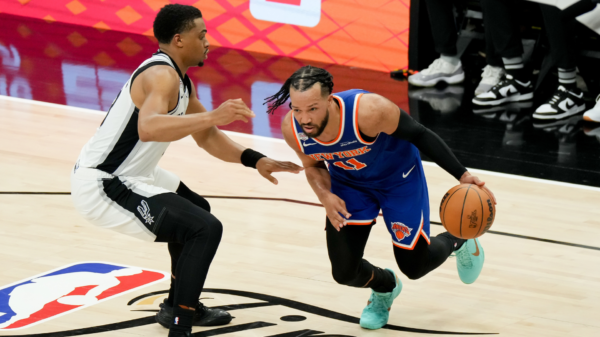
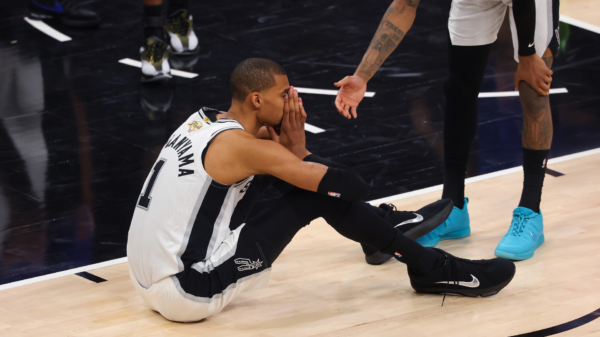
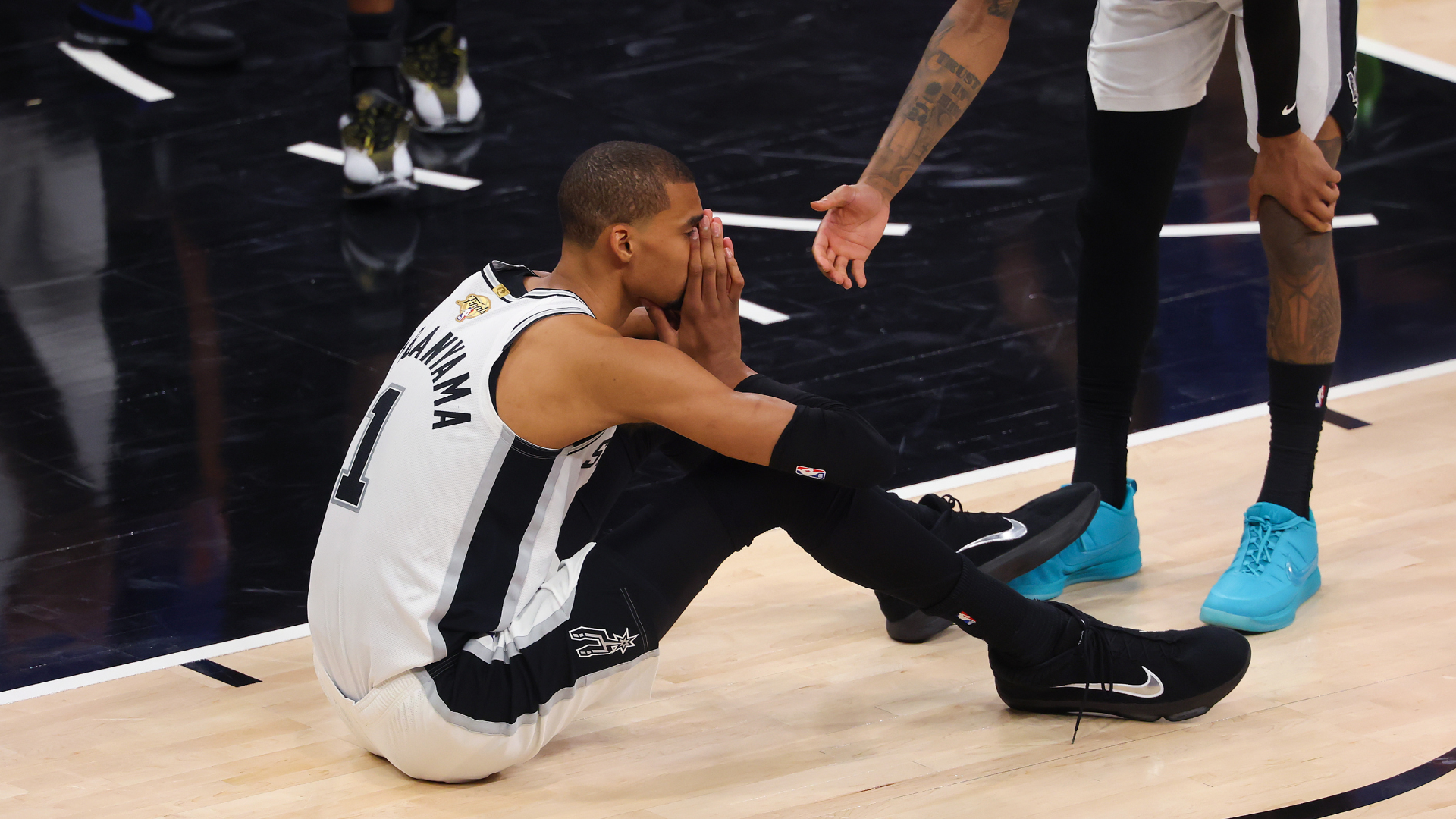
His nightmarish turnover at the end of Game 2, the one that gave the New York Knicks an out-of-nowhere shot at a regulation victory at a point in which their best-case outcome was grinding through overtime, might genuinely have been the lowlight of his career if not for what came next. In Game 4, Wembanyama’s San Antonio Spurs blew a Finals record 29-point lead in the second half of what is perhaps the most stunning Finals result in NBA history. Wembanyama shot 3-of-14 in the second half. Jalen Brunson attacked him in pick-and-roll. He missed two free throws that could have given the Spurs a three-point lead in the last two minutes. He collapsed. His whole team did.
Finals performances, for better or worse, are immortalized. That’s just how it goes. Those miscues are going to live with him forever. The good news is that we’re pretty eager to recontextualize them over time. Very few players have ever really scaled the mountain Wembanyama is trying to climb. Something a lot of them share is heartbreak.
The obvious comparison would be LeBron James. He didn’t just lose his early trips to the Finals. He was humiliated in them. Like Wembanyama, he reached the Finals for the first time in his age-22 season. Unlike Wembanyama, he was swept out of his first attempt, ironically enough, by the Spurs in 2007. But things were much worse in his second attempt.
The 2011 Finals are the defining loss of James’ career, and the season that took him there shares some similarities to the one Wembanyama just endured. He was the best player on a team going through its first playoff run together. His team didn’t have the top seed in its conference, but he knocked off the MVP, in his case Derrick Rose, in the conference finals to reach the biggest stage. The assumption heading into the Finals was that the series was a formality and it would serve as his coronation. That was the first and really only season James, in his first year with the Miami Heat after his controversial exit from Cleveland, truly spent playing a villain. Wembanyama toyed with villainy in the Finals, but really, it was just his first season as the NBA’s defining star.
The weight of that spotlight takes some getting used to. Spending a year as America’s most hated athlete finally wore James down against the Dallas Mavericks. The clips of 5-foot-10 JJ Barea defending him in the post are fuel for his critics to this day. His streak of 1,297 consecutive games with double-digit points is a lie because it only covers the regular season and he was held to just eight points in Miami’s Game 4 defeat.
We’ll never know fully what sort of toll this season took on Wembanyama mentally. Physically, Wembanyama was visibly worn down as the Finals progressed and the Spurs eventually bowed out to the Knicks in five games, capped off by Saturday night’s 94-90 loss that saw him score 19 while going just 7 of 19 from the field.
Almost every all-time great has lived a version of this story. Kobe Bryant infamously shot four airballs in five minutes in crunch time of a 1997 playoff game against the Utah Jazz. Dirk Nowitzki became the first European player ever to win MVP in 2007… but had to collect his trophy at a news conference rather than before a playoff game because his 67-win Mavericks became the second No. 1 seed in NBA history to lose a first-round series to a No. 8 seed, the Golden State Warriors. James Worthy’s first NBA Finals in 1984 are remembered in part the same way that Wembanyama’s first Finals will be. The series Worthy blew in Game 2 with a bad pass allowed Boston to tie the game at the end of regulation.
Moments like this aren’t exclusive to players without rings. Those same 1984 Finals ended with two-time champion Magic Johnson being rechristened “Tragic” Johnson for his late-game miscues. Stephen Curry won a championship in 2015, but in his 2016 loss to James, in which his 73-9 Warriors blew a 3-1 Finals lead, Curry threw a behind-the-back pass out of bounds with around five minutes left in Game 7. He’s called that pass his only regret as a player.
One day, Wembanyama may feel the same about his own ill-fated pass. After all, these aforementioned greats eventually recovered. Worthy’s nickname is now “Big Game James.” Nowitzki won the 2011 Finals against the same Heat franchise that beat him in 2006. Johnson would win three more championships and three MVPs after his 1984 loss to Boston. Curry similarly added three more rings. Bryant won five and never let those airballs scare him out of taking another big shot.
Over time, those mistakes become lessons. They’re the moments that set up the moments. All of Bryant’s big shots mean that much more because of the airballs that preceded them. We treasure Johnson’s magic in part because we remember when he was tragic.
Think of the weight of Game 6 of the 2012 Eastern Conference Finals. James hadn’t won a championship yet. He’d blown the 2011 Finals. He’d lost to Boston in two previous playoff series, and he was down 3-2 on the road, knowing that yet another failure would get pinned on him forever. It led to perhaps the most memorable game of his career, a 45-point assassination of the Celtics after which he was never the same. James’ big-game credentials were unquestionable from that point forward.
James is one of the two players Wembanyama will forever be judged against. The other is Michael Jordan, whose career included defeat, most famously against the Detroit Pistons. He never quite had the level of individual heartbreak that James, Bryant, or all the others endured. There is no notable choke on his part, no loss that is directly pinned on him. As NBA resumes go, Jordan’s is as close to spotless as it gets.
But James’ mere presence in the “greatest of all time” conversation proves that imperfections aren’t disqualifying. Larry Bird never reached the depths of “Tragic” Johnson, but when the two legendary rivals are compared, you’ll find no shortage of Johnson backers. The same can be said of the rivalry between Bryant and Tim Duncan. The superstar big man who preceded Wembanyama in San Antonio won his first championship in his second season and didn’t lose in the Finals until his 16th.
It’d be naive to pretend that players aren’t judged for who they are at their worst, but time and success tend to heal wounds. We don’t remember James for 2011. We remember him for 2012, 2013, 2016 and 2020. Bryant’s airballs are a footnote. Johnson is now and forever “Magic.”
Wembanyama was close enough to the summit that he could nearly reach it. The Knicks knocked him back to the bottom of the mountain. The climb back up begins now. And one day, if and when he plants his flag at the top, we’ll look back on the stumbles he took to get there as part of the journey, not any sort of stain on the destination.
