


















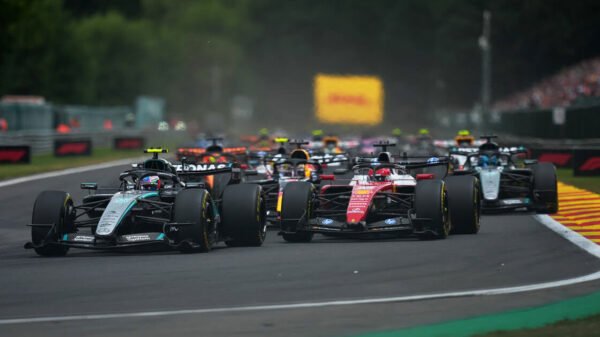
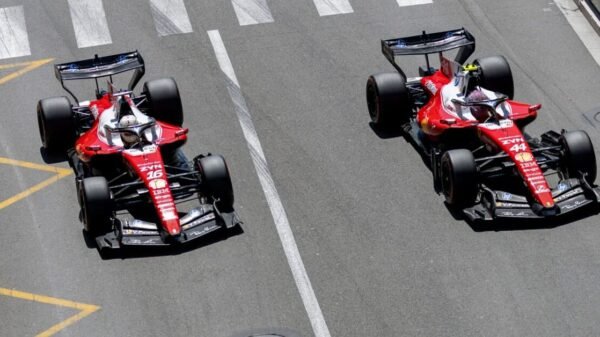
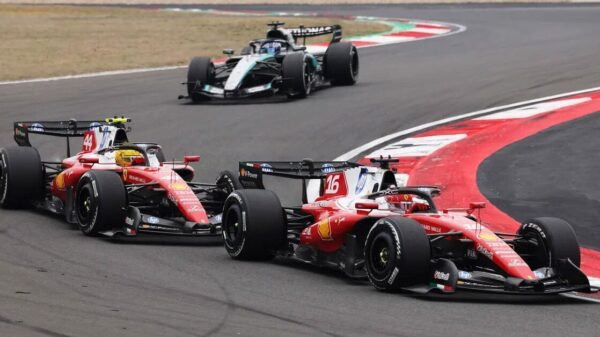














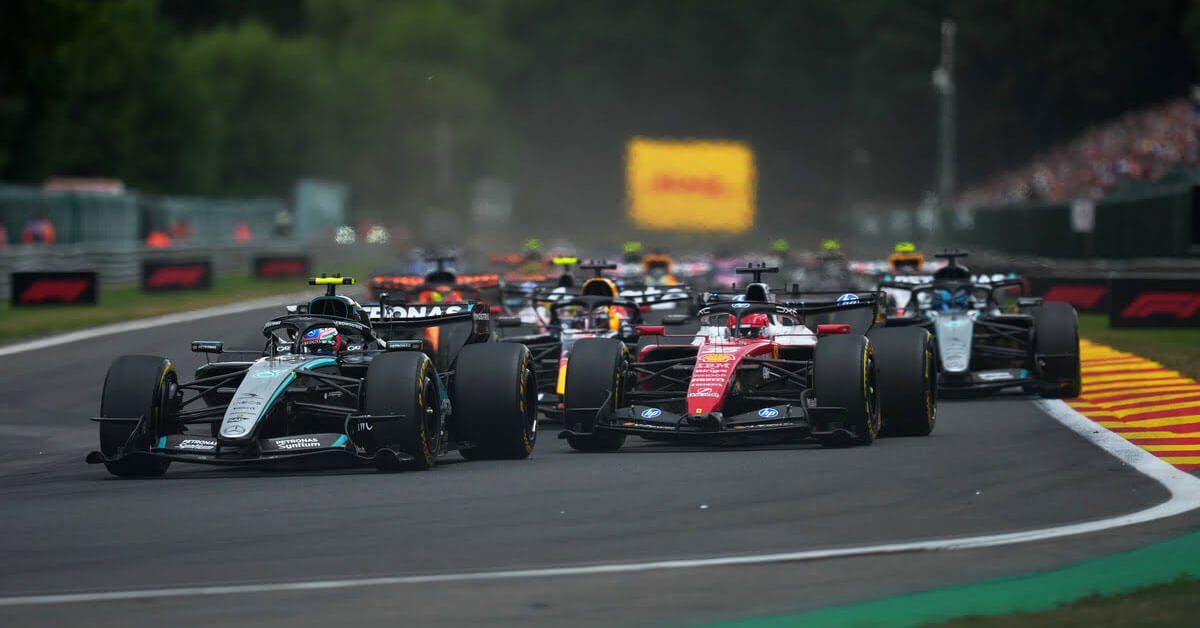
The high number of overtakes seen at the 2026 Las Vegas Grand Prix highlighted a major strategic element introduced by Formula 1’s new technical regulations: the significant value of the slipstream. Drivers trailing other cars frequently gained speed advantages ranging from 20 to 30 km/h, while those trying to pass faced disadvantages.
Technical Factors Behind Slipstream Effectiveness
The effectiveness of following a car goes beyond standard aerodynamics under the 2026 rules. Following another vehicle can also decrease electrical energy consumption and extend power deployment, creating advantages that persist past the straightaway.
This effect was particularly noticeable at Las Vegas when comparing cars with similar performance levels, even against circuits like Monza, traditionally known for speed.
Aerodynamic Drag and Speed
All F1 cars must overcome air resistance, meaning a large portion of the power unit’s output is used just to maintain speed rather than accelerate.
Aerodynamic drag increases with the square of vehicle speed. More critically, the power needed to overcome this resistance rises even faster—it increases with the cube of speed.
For instance, increasing a car’s speed from 300 km/h to 330 km/h represents only a 10% speed increase, but overcoming air resistance alone at the higher speed demands about 33% more power.
How Slipstream Reduces Resistance
When an F1 car moves through the air, it creates a complex aerodynamic wake. In this region, the airflow velocity is lower than in undisturbed flow, and pressure variations occur.
From a stationary view, the following car encounters airflow with a lower average relative velocity. This generally lowers the drag experienced by the chasing car.
It is important to note that the slipstream does not reduce air density, nor does the leading car physically pull the following vehicle forward; the advantage comes from changes in airflow velocity and pressure distribution.
The Power Saving Calculation
A simplified calculation illustrates the potential gains. If a car needs 500 kW to overcome drag at a certain speed, a 10% reduction in drag due to another car would require the following car to use about 50 kW less power to maintain that speed.
This theoretical saving equates to roughly 68 horsepower. If the drag reduction reaches 20%, the saving is approximately 100 kW, or around 136 horsepower.
The slipstream does not boost the actual output of the power unit; rather, it lowers the amount of power consumed by aerodynamic resistance, freeing up more available output for acceleration.
Theoretical Speed Advantages
Calculations show that a reduction in aerodynamic drag translates to potential speed increases. Theoretically, if a car reaches 320 km/h in clean air, a 20% drag reduction could result in a theoretical maximum speed of 344.7 km/h, yielding a +24.7 km/h advantage.
These calculations are theoretical and exclude real-world factors like straight length or transmission ratios, but they explain why speed differences between competitive cars can reach 20 to 30 km/h in favorable slipstream conditions.
Complementary Advantages of Following
The FIA documentation for the 2026 Las Vegas Grand Prix outlines how Overtake Mode adds to these benefits. Under standard conditions, maximum electrical power drops after 290 km/h.
With Overtake Mode active, a driver can theoretically maintain the maximum electrical output of 350 kW until about 337.5 km/h, provided energy is available. This mode also allows for an extra 0.5 MJ of energy recovery per lap.
A following car benefits from three combined factors: reduced aerodynamic resistance, improved electrical energy conservation from the slipstream, and extended high-speed electrical deployment when Overtake Mode is used.
Strategic Considerations
Under the 2026 regulations, remaining behind a car can reduce energy consumption and preserve electrical energy for later in the lap. This shifts race management; drivers must decide if an overtake is strategically best at that moment.
Taking the lead too early might mean approaching the next straight without the benefit of slipstream, with less available electrical energy and a faster opponent right behind.
Considering these combined aerodynamic and energy factors, how does this new dynamic influence racecraft?
