

















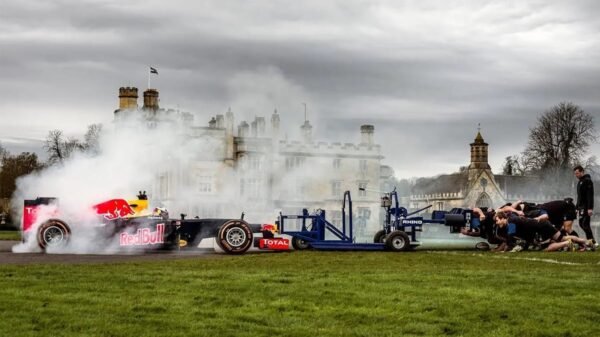
















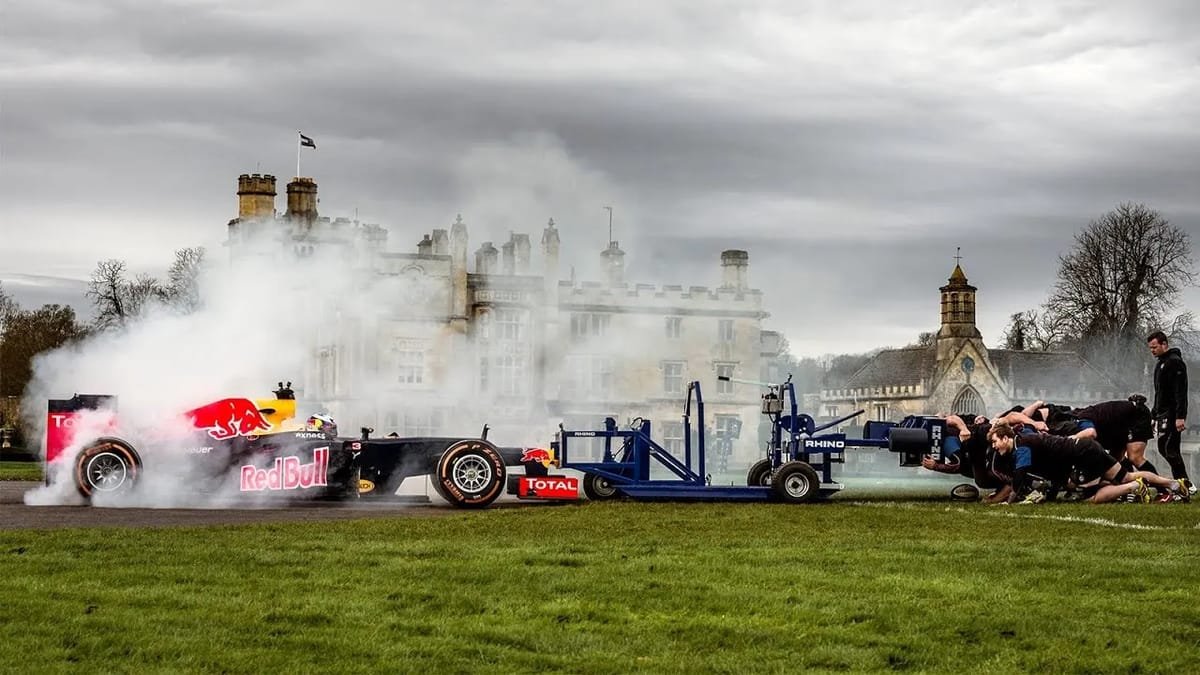
In a highly unconventional demonstration of raw power, Red Bull pitted one of its championship-winning Formula 1 cars against an entire rugby team for a unique strength test. This event, which took place in 2016 when Daniel Ricciardo was a driver for the team, served as a striking piece of marketing, showcasing the sheer potency of their machinery.
Technical Details of the Test Subject
The machine involved in this epic confrontation was a 2012 RB8, a car that held significant championship pedigree. This vehicle was driven by Sebastian Vettel and Mark Webber during its competitive run. The car was equipped with a 750hp V8 power unit, making it a potent piece of engineering. For this specific strength test, the car received a special nose appendage, which was necessary to allow it to engage with the scrum machine used by the opposing team.
The opponent was the eight-man squad from Bath Rugby Club. As documented in the resulting video, the engagement between the highly advanced F1 car and the formidable rugby team proved to be an incredibly balanced and intense matchup, with both sides pushing each other to their absolute limits.
Intended Performance Impact of the Machinery
While the context of this test was purely demonstrative and not related to track performance, the underlying characteristics of the RB8 are relevant to understanding its capabilities. The F1 car, despite its immense power, is inherently very light. The interaction demonstrated the contrast between the brute strength of a professional rugby team and the focused, high-energy power output of a modern, lightweight F1 chassis.
Competitive Context and Pedigree
The 2012 RB8 carries a significant history. It was the car that secured the Constructors’ title for Red Bull that season, even after a somewhat slow start to the competitive 2012 campaign. That year was exceptionally competitive, featuring notable performances from rivals, such as the Williams team securing a victory for the first time since 2004. The RB8 itself accumulated 14 podium finishes and eight pole positions during its tenure.
Red Bull’s journey in Formula 1 spans back to 2005, when the Milton Keynes outfit entered the sport after acquiring Jaguar Racing. The team’s ascent has been marked by dominant periods, including the 2010–2013 era where Vettel and his squad achieved four consecutive Drivers’ and Constructors’ Championships. More recently, the team has seen significant evolution, including a shift to Honda power units in 2019 and the ground-effect era of 2022–2023, which saw them win 21 of 22 races in 2023.
Season Implications and Development Trajectory
While the rugby scrum test is a historical anecdote, it reflects the underlying ethos of Red Bull: pushing boundaries and testing limits. The team’s development direction has consistently been towards maximizing efficiency and power delivery, as seen in their transition to in-house Ford-partnered power units slated for 2026. The resources allocated to the team reflect a continuous drive for peak performance, whether that is through aerodynamic refinement or powertrain innovation.
What to Watch Next
For fans tracking the current development cycle, the focus remains on the ongoing validation phases for upcoming races. The team’s continuous technical updates are always scrutinized, as every small change signals the direction of the competitive edge they are seeking. The next few races will provide crucial data points on how recent upgrades translate into on-track performance against the competition.
Given the team’s history of rapid evolution, how much of the current performance advantage is attributable to fundamental design philosophy versus incremental component upgrades?