





















We’re back for the third edition of the summer scouting series. This week, we’ll dive into a highly talented group. There’s a wide variety of skill sets in this list, from players who excel at creating separation to those who consistently convert contested chances.
The top of this list is headlined by a few players who have been under the microscope since their freshman season. Fast forward three years, and they’ll battle it out to solidify the top of the rankings behind No. 1.
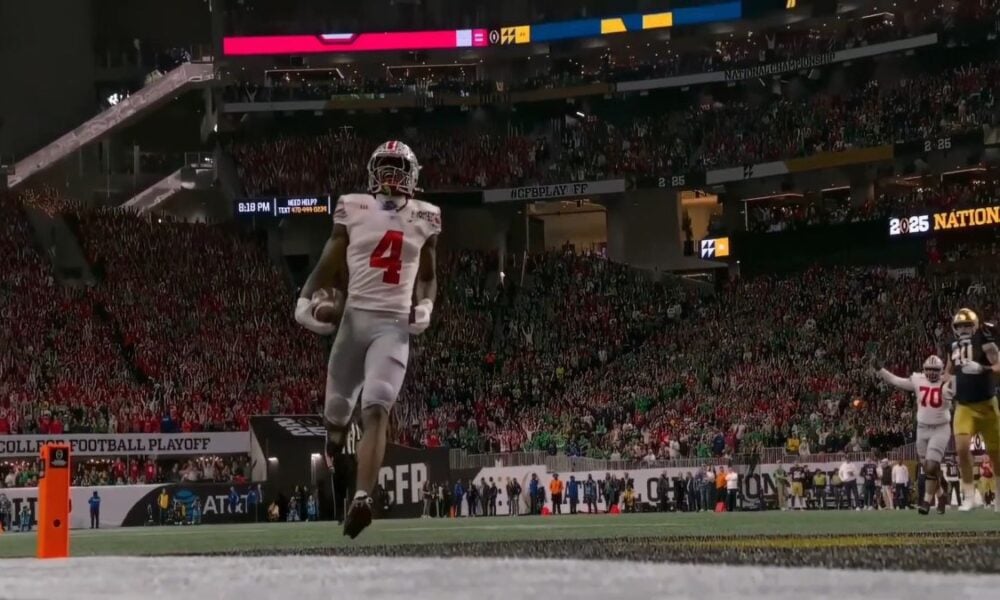
1. Jeremiah Smith/Ohio State (Third-year Junior)
Analysis: This is arguably the most concrete ranking for next year’s class. Smith has widely been considered not only the best receiver, but the best overall player in college football over the past couple of seasons. He’s garnered comparisons to a young Julio Jones as a prospect. I’m not willing to fully go there, but he’s easily the most talked-up receiving prospect since Jones.
Hype like this doesn’t exist without the talent to back it up, and Smith is the complete package. He possesses a freakish size-speed combination, paired with an advanced understanding of route leverage and spatial awareness. While other big receivers rely on boxing out defenders, Smith can snap off routes with the suddenness of much smaller players. He alters his tempo to lull defensive backs to sleep before accelerating past them with his burst.
For as good as he is, route running isn’t even his calling card. His ball-tracking ability is undoubtedly elite. He consistently uses late hands to keep defensive backs from playing through the catch point and snares passes outside his frame with a massive catch radius. Smith has routinely made highlight-reel plays through his first two seasons, making the difficult look effortless.
The best description of him as a receiver is “borderline uncoverable.” Fittingly, the biggest knock on Smith is a slight inconsistency in run-blocking technique. With his size, he should dominate on the boundary, but he tends to lunge at defenders. When the play develops away from him, he can show noticeable disinterest as a blocker.
When effort and blocking technique are the primary complaints, a prospect rarely has many weaknesses. With Smith, the question isn’t where he lands in these rankings, but how high he’s selected in the draft.
Preseason Draft Projection: Early Day One
2. Cam Coleman/Texas (Third-year Junior)
Analysis: The rankings truly begin after Smith, and Coleman is the first in line as the favorite to claim this spot. He might be the most talked-about receiver in the country and the biggest threat to Smith’s throne—if there is one.
His time at Auburn was marred by systemic passing limitations and inconsistent quarterback play, yet his talent still shone through the turmoil. After transferring to Texas, he’ll have every opportunity to solidify himself as an early draft choice while catching passes from highly touted Arch Manning.
At 6-3, Coleman is the quintessential perimeter vertical separator. He’s a long strider who eats up cushion in a hurry, immediately stressing cornerbacks in off coverage. His best work comes when he’s isolated on the boundary, where he can use his gazelle-like leaping ability to high-point the football. He also shows excellent spatial awareness near the sideline, routinely dragging his toes and playing with a smoothness that’s rare for receivers his size.
Coleman will be a box-office talent for Texas, and his raw ability is undeniable. However, his route tree remains rudimentary compared to his peers. He’s leaned heavily on go routes, deep posts, and tough back-shoulder catches. To become a true multi-level threat, he’ll need to further refine his transitions on in-breaking routes and expand his overall route inventory.
This season at Texas is shaping up as a make-or-break campaign. Circumstances have held Coleman back in the past, but that excuse disappears with Manning at quarterback and Steve Sarkisian calling the plays. His talent makes him Smith’s top rival, but he has to deliver.
Preseason Draft Projection: Early Round One
3. Ryan Coleman-Williams/Alabama (Third-year Junior)
Analysis: After a stellar freshman campaign, Coleman-Williams was once considered 1B to Smith’s 1A. A subpar sophomore season clouded that outlook. Because of the highs and lows of his career so far, he’s the most polarizing on-field prospect in this class. Despite the dip in volume and efficiency, his film remains explosive and Coleman-Williams still warrants early-round conversation.
He primarily operates as a vertical separator and a utility weapon from the slot or backfield. His biggest strength is his lateral suddenness. He possesses top-tier cut quickness and hip fluidity, allowing him to exit breaks at near top speed without noticeable deceleration. Even with his statistical dip as a sophomore, Coleman-Williams consistently found ways to create separation.
His post-catch field vision is also a spectacle. When he’s manufactured touches in space, he looks like an explosive punt returner. Combining his lateral agility with outstanding open-field vision and feel for spacing, he’s produced a long list of highlight plays after the catch.
The most concerning part of his game is his lack of consistency, especially with his hands. While his drops were put under the microscope as a sophomore, catching the ball has never truly been a strength—not even as a freshman. That second-year slump only amplified the issue. Through two seasons, Coleman-Williams has 17 drops. He can get open at an elite level, but it won’t matter if he can’t consistently secure the catch.
His upcoming season will be closely watched. No one in this group has a wider range of draft outcomes. If he breaks out, he can push for the No. 2 spot. If he falters again, his stock could tumble.
Preseason Draft Projection: Day One
4. Nick Marsh/Indiana (Third-year Junior)
Analysis: Marsh is another former true freshman standout. While he didn’t post the same numbers as the receivers above him, he dealt with a similar issue as Coleman: an inept offense held back by inconsistent quarterback play. Even so, Marsh’s talent still broke through. He set Michigan State’s true freshman records for receptions (41) and yards (649).
After transferring to the defending national champion Hoosiers, Marsh could help usher in a shift in offensive philosophy. Despite having QB Fernando Mendoza, the No. 1 overall pick in the 2026 NFL Draft, last year, Indiana’s success was largely built on physicality and a dominant run game. Adding Marsh, a physical anomaly who blends possession-receiver size with surprising post-catch burst, could signal a move toward a more balanced attack.
In a class that already includes an electric after-the-catch threat like Coleman-Williams, Marsh might be the best pure tackle breaker of the group. Last season, he forced 28 missed tackles, routinely generating hidden yardage despite not being a true burner.
He wins with his frame at the catch point, consistently boxing out defenders and finishing through heavy traffic. Marsh absorbs contact well and rarely looks bothered by bodies around him.
His biggest weakness is a lack of top-end vertical speed. He doesn’t have the pure breakaway gear to consistently threaten the deep thirds. The positive: he clearly understands his limitations and has carved out a niche working the intermediate areas of the field.
The Marsh–Indiana pairing will be fascinating to track. His prospect profile already has him in the first-round conversation. If Indiana leans heavily on the run again, evaluators will focus closely on how Marsh is featured and developed in the passing game.
Preseason Draft Projection: Day One
5. Charlie Becker/Indiana (Third-year Junior)
Analysis: Indiana has a chance to field the most dynamic receiving tandem in the country. While Marsh draws most of the national attention, Becker has quietly established himself as one of the more detailed and reliable receivers in college football.
Despite only becoming a full-time starter midway through last season after a teammate’s injury, Becker produced at a high clip. Posting 34 receptions for nearly 700 yards in that span is no easy feat and outpaced plenty of receivers who started all year.
Becker thrives against zone coverage. He’s a classic chain-mover who excels at identifying soft spots in defensive shells and understands the timing required to sit in voids and present a big target to his quarterback. Though Marsh is listed at 6-3, Becker actually checks in even taller at 6-4, which further amplifies his value over the middle.
His ability to separate versus zone translates well to the league, and his strongest trait might be his hands— “magnets,” as he calls them. Despite being heavily targeted down the stretch and during the Hoosiers’ playoff run, Becker finished the season with zero drops. He showcases elite concentration and hand-eye coordination.
His body control is also top-notch, with the ability to adjust mid-air to secure off-target throws downfield. While he generated big plays for the Hoosiers, his top-end speed isn’t eye-popping. He’s not a liability, but he’s also unlikely to consistently run away from NFL-caliber corners.
Entering the season as a full-time starter will give scouts a much deeper library of tape. He’s a strong candidate to put together a standout season that cements him as an early target in next year’s draft.
Preseason Draft Projection: Early Day Two
6. Mario Craver/Texas A&M (Third-year Junior)
Analysis: KC Concepcion went in the first round last month, and you can make a case he wasn’t even the best receiver in that room. When you compare profiles, it’s not hard to get excited about Craver’s upside.
He outpaced Concepcion statistically for most of last year. Craver finished the season near the top of the SEC in missed tackles forced (22), yards after the catch (575), and Pro Football Football receiving grade (82.7).
Those numbers summarize his game: he’s explosive with the ball in his hands and has lethal speed. Like Concepcion, Craver is a savant after the catch. From the slot, he uses his explosiveness to make sharp, efficient breaks and uncover quickly. After averaging 15.5 yards per touch in 2025, Texas A&M will scheme touches for him early and often.
The major concern is his size. At 5-9 and 165 pounds, it’s hard to see him pushing near the very top of the draft. Even with elite speed, he’s almost certainly locked into a primary slot role, and he’ll still be undersized there.
That said, he simply gets open. He’s an efficient mover with outstanding route tempo off the line and through his stems. With his burst and change-of-direction ability, he can create consistent mismatches against nickel corners and linebackers.
Craver’s goal this season will be to prove that his size doesn’t diminish his impact. At just 20 years old, he has time to add to his frame. If he does—and if the production scales—his ceiling is sky high.
Preseason Draft Projection: Day Two
7. Wyatt Young/Oklahoma State (Third-year Junior)
Analysis: Two of the most talked-about Group of 5 players last season are now in Stillwater. Quarterback Drew Mestemaker has already appeared in the top 10 of our preseason quarterback rankings, and his go-to weapon followed him to Oklahoma State.
Young was one of the most prolific receivers in the nation last season, even when compared to Power 4 pass catchers. At North Texas, he posted the second-most receiving yards in school history for a single season (1,264) along with 70 catches and 10 touchdowns.
While PFF grades can be polarizing, Young posted an 89.9 receiving grade—third-best in the country, trailing only Makai Lemon and Jeremiah Smith. And his 3.69 yards per route run ranked first among returning receivers. He became one of the most dangerous wideouts in college football thanks to his yards-after-catch prowess and savvy route manipulation.
Young’s physicality after the catch is his calling card. He doesn’t simply rely on open-field speed. He seeks out contact and breaks tackles. Despite weighing just 195 pounds, he led all FBS wideouts in 2025 with 385 yards after contact and forced 32 missed tackles. The former high school quarterback turns into a running back the moment he secures the ball.
Like Craver, Young has operated almost exclusively from the slot. He’s not as explosive, but there’s more nuance to his game. He uses subtle pacing, shoulder leans, and head fakes to manipulate second-level defenders and settle into space versus zone.
The primary question, similar with Mestemaker, is competition level. Young thrived in a high-octane scheme against largely lower-tier opponents, which creates some natural skepticism.
If his craftsmanship translates to the Big 12 against stiffer competition, his stock could skyrocket. His decision to declare for the 2027 draft may be closely tied to Mestemaker’s.
Preseason Draft Projection: Day Two
8. Duce Robinson/Florida State (Fourth-year Senior)
Analysis: Amid the turmoil at Florida State, Robinson was a bright spot last season. The towering pass catcher stands 6-6 and weighs 230 pounds but moves with the fluidity of a much smaller player. He blurs the line between traditional wide receiver and move tight end.
Coming out of high school, Robinson was not only a top football recruit but also a legitimate MLB draft candidate. He chose football and promptly became the first Seminoles receiver to eclipse 1,000 yards in a season since 2019.
For his size, movement is not an issue. Robinson has surprisingly fluid stop-start ability that allows him to run a deeper and more complex route tree than most expect from someone his build. The concern, ironically, is physicality.
Robinson towers over most of his matchups, but he often plays like he’s unaware of his size advantage. Against more physical corners, he can be bullied and rerouted too easily at the line and through his stem.
When he plays up to his frame, though, he’s unguardable. His rare length, body control, and catch radius are going to be catnip for NFL teams. Despite his struggles with physical play early in routes, he’s dominant in contested-catch situations. He consistently shields defenders with his body and offers a nearly unstoppable red-zone target.
All eyes will be on Robinson to carry the Seminoles offense this year. Game plans will be built around him, and how he responds to that attention will determine how far he can rise on this list.
Preseason Draft Projection: Day Two
9. Omarion Miller/Arizona State (Fourth-year Senior)
Analysis: After spending the first three years of his career in Boulder, Colorado, Miller transferred to Arizona State. As the successor to first-round pick Jordyn Tyson, he brings a big-bodied, traditional X-receiver profile. Last season, he led the Buffaloes in catches, yards, and touchdowns—and paced the Big 12 with 18 yards per reception.
Miller’s hallmarks are his work at the catch point and ability to track the football. He’s very comfortable with a defender in his hip pocket and knows how to use his frame as a barrier. Miller tracks the ball naturally and shows high-level body control when adjusting to back-shoulder or underthrown passes.
He does his best work as a route runner on vertical routes. His release package currently leans more on strength than footwork. Too often, his feet look heavy, which hurts him at the line of scrimmage and through his transitions. He tends to round his breaks, giving defensive backs time to close.
Miller doesn’t have top-end burner speed and lacks the sudden twitch to fully compensate. He may never be an unquestioned alpha WR1, but he brings reliability, size, and legitimate big-play ability after the catch.
Replacing Tyson is a tall task, but Miller is a capable fill-in who can carve out a big role in Arizona State’s passing game.
Preseason Draft Projection: Day Two
10. Nyck Harbor/South Carolina (Fourth-year Senior)
Analysis: Harbor is arguably the toughest evaluation in this class. He has the potential and physical tools to be a top-three receiver in the group, but three years in, many of the same deficiencies still cap his ceiling.
At 6-5 and 235 pounds, Harbor is a true athletic unicorn. Even with his frame, it would be disappointing not to see him clock in the 4.3s. Before fully committing to football, he posted freakish track times: a 10.28-second 100-meter dash and a 20.79-second 200-meter.
There’s no debate about his biggest strength: elite speed in a massive body. His physical tools give him a vertical ceiling that separates him from his peers. His straight-line speed is nightmare fuel for defensive coordinators.
Everything beyond the raw traits remains a work in progress. Harbor has a hard time sinking his hips at the top of routes, leading to rounded breaks that defenders can anticipate. He also plays too upright out of his stance, exposing his chest and allowing corners to disrupt him before he reaches top gear.
If he can finally put it all together as a senior, a team will be willing to bank on his traits early in the draft. Players with his kind of size-speed combo are rare. DK Metcalf is the only real comparison in recent memory.
Until he refines the nuances of the position though, he remains more of a one-trick vertical weapon than a complete receiver.
Preseason Draft Projection: Day Two
Honorable Mentions: Ryan Wingo/Texas, T.J. Moore/Clemson, Jordan Faison/Notre Dame, KJ Duff/Rutgers, Eugene Wilson III/LSU, Bryant Wesco Jr./Clemson
