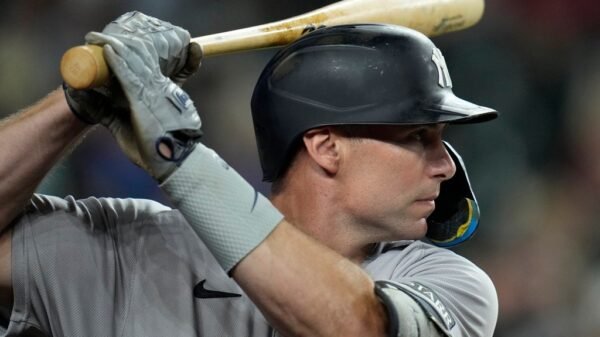













The collective bargaining agreement (CBA) between Major League Baseball and the MLB Players Association is set to expire on December 1, with both sides reportedly far apart during negotiations for a new deal.
Current CBA Expiration and Lockout Details
The current CBA, which serves as the employment contract between MLB team owners and the players’ union, expires at 11:59 p.m. ET on December 1. This agreement was signed on March 10, 2022.
If a lockout occurs, it signifies a work stoppage and a freeze on communication between the two parties until a new CBA is agreed upon. During a lockout, all player activity ceases, meaning no trades or free-agent signings can take place. Players are also prohibited from communicating with any team personnel, including medical and training staff.
In early October, MLB sent a memo to league employees outlining how club owners and executives should operate during a lockout; this included stating that while holiday cards should not be sent to players, attending their weddings was permissible.
Lockout Versus Strike
Both a strike and a lockout are forms of work stoppage, but they differ in which party initiates them. A strike happens when the players, led by the MLBPA, choose to withhold their services and refuse to play. The most recent strike occurred in 1994, which resulted in the cancellation of that season’s World Series.
Conversely, a lockout occurs when the league and its owners prevent labor, in this case players, from reporting for work. When the last CBA expired on December 1, 2021, MLB team owners imposed a lockout.
Both tactics are used during negotiations to gain leverage and push one side’s demands. A work stoppage does not guarantee that regular-season games will be missed, but it remains a possibility, potentially impacting spring training games in 2027.
Points of Contention
The primary point of contention between the league and the players’ union revolves around a salary cap—a limit on the total amount any single team can spend on player salaries.
For years, the concept of a salary cap has been difficult for the players’ union to sustain as a sticking point in CBA talks. Instead, the league and its owners have focused on other methods to improve their financial standing, such as adjusting the luxury tax with thresholds that penalize teams with high payrolls by charging overage taxes and affecting draft positioning.
The most recent CBA also included wins for club owners, including expanding the postseason from 10 to 12 teams (a compromise between the league’s pursuit of 14 teams), allowing advertising on team helmets and uniforms, and establishing a Joint Competition Committee comprising six ownership representatives, four players, and one umpire.
According to Shusterman, with the Dodgers’ back-to-back championships fueled partly by their high payroll, the league seems highly motivated to push for a salary cap, even with the Milwaukee Brewers winning the 2026 World Series.
Proposals from Both Sides
League Proposals
Management’s desire for a salary cap is highlighted as a fundamental potential alteration to the sport. The new system, based on an MLB proposal from the summer, would also incorporate a salary floor.
MLB has introduced several other changes in its most recent proposal released on October 8. These include ideas for a 154-game regular season, a seven-game division series, a weekly off day, and allowing higher-seeded playoff teams to select opponents in the first two rounds.
Other league propositions mentioned are: reducing pre-free-agency years from six to five for players aged 30 or older; capping contract length at five years; abolishing the qualifying offer; imposing more restrictions on roster modifications; implementing an offseason signing window and transaction freeze; and completely overhauling how amateur players enter professional baseball in both domestic and international markets.
Union Proposals
The MLBPA appears to be seeking less drastic changes compared to the league’s proposed transformations. The union’s messaging has focused on opposing a salary cap, stating that any system involving a cap is a “flat-out nonstarter for the players.”
Since bargaining began earlier this year, the MLBPA has submitted proposals detailing player benefits, such as significant increases to minimum salaries; stricter rules to prevent service-time manipulation; increases to luxury-tax thresholds; and a new “competitive integrity” tax on teams that do not spend above a certain level.
The union also proposed expanding active rosters from 26 to 28 players early in the season to help protect against injuries, and banning prop bets targeting individual players to reduce gambling-related harassment.
Timeline and Future Dates
Key Dates
December 1 is noted as a critical date, though owners locking out players on that day is considered certain. Negotiations are not expected to accelerate before this deadline.
The next significant marker is the week of February 9, when pitchers and catchers typically report to spring training complexes, about 45 days before Opening Day. This date will be symbolic but will not trigger tangible bargaining action.
Around March 10, another important cutoff exists. A lack of a new CBA by this time would require a revision of the 2027 regular-season schedule. During the last labor cycle, the agreement on March 10 delayed Opening Day by one week, but MLB still managed to fit in 162 games by pushing the postseason back.
Mintz suggests that the line in the sand for viability regarding a 162-game season is likely around March 15, given the necessary weeks for spring training ramp-up.
Outlook for the 2027 Season
The 2027 regular season was scheduled by MLB to begin with “Opening Night” on Wednesday, March 24, followed by a full Opening Day slate on Thursday, March 25. However, referencing the lockout five years ago, these dates could change if talks continue.
On March 1, 2022, Manfred issued a letter to baseball fans stating that “the calendar dictates that we are not going to be able to play the first two series of regular season games and those games are officially canceled.” Following another week without resolution, MLB announced further schedule cuts, noting that “because of the logistical realities of the calendar, another two series are being removed from the schedule, meaning that Opening Day is postponed until April 14th.”
When a deal was reached on March 10—three weeks before the original Opening Day—both sides agreed to a compressed spring training and adjusted slate featuring extra doubleheaders and a later finish, allowing all 162 games to be played while only delaying the season by eight days.
Given the current climate, it is unlikely that Opening Night on March 24 will occur as scheduled. While past experience shows declarations of canceled games should not be taken at face value, the limits of flexibility needed to fit in all 162 games remain unclear, and increased willingness from both sides to accept a shorter schedule is possible.
As of now, Opening Day 2027 remains March 24. Will baseball be available to watch on that day?