














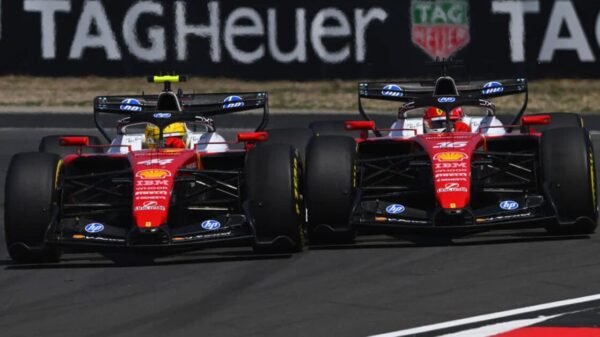










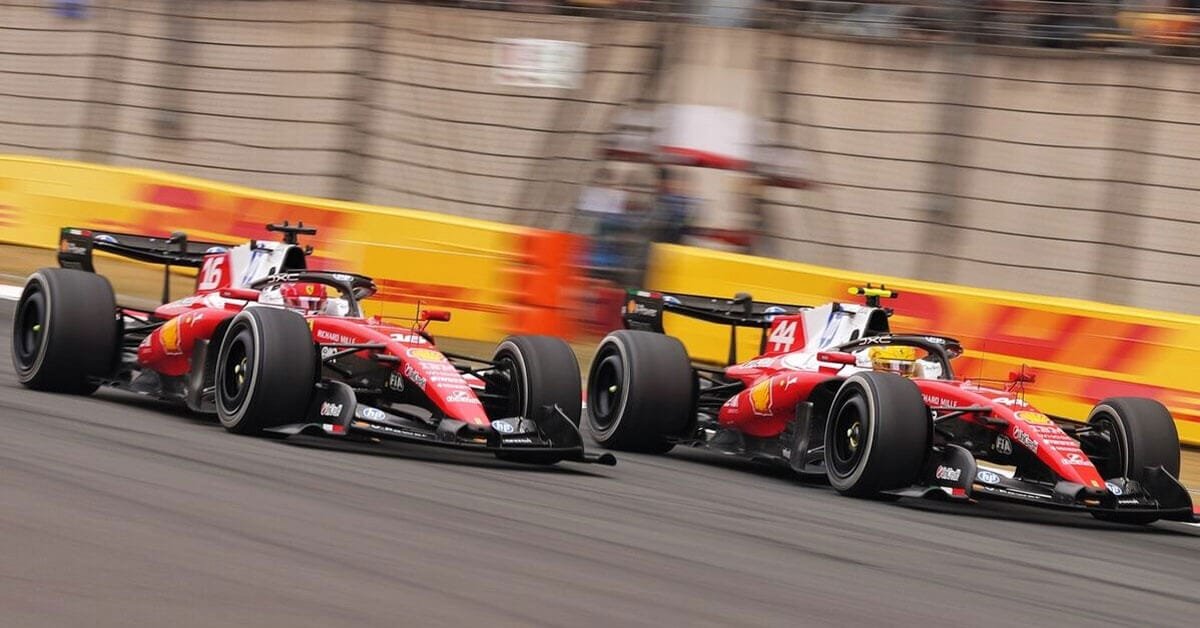
The recent incidents involving Charles Leclerc and Lewis Hamilton have brought renewed focus to warnings from former Ferrari engineer Luigi Mazzola regarding internal driver rivalry.
Ferrari’s Potential vs. Reality
While the Ferrari SF-26 is not considered the fastest car on the grid, it possesses potential that should not be overlooked.
The Mexican Grand Prix highlighted what Scuderia could have achieved when the car’s competitiveness allowed for a significant result, suggesting a challenge for victory was possible.
However, team performance and driver incidents during that event raised questions about Ferrari’s ability to maximize the machinery available.
Mazzola on Team Unity
Luigi Mazzola previously addressed issues of driver egos, internal management, and the necessity of a shared goal in an interview conducted before the recent Leclerc and Hamilton incidents.
His observations are relevant because Ferrari’s challenges involve both the SF-26’s competitiveness and the team’s capacity to utilize its potential.
“They should build a relationship, a way of behaving and a way of looking together towards a single objective, which is ultimately to win,” Mazzola stated.
The Importance of Capitalizing on Opportunities
It must be understood that the SF-26 lacks the dominance of benchmark cars in the championship.
Yet, disappointing results cannot always be attributed solely to car limitations.
The Mexican Grand Prix showed how even an imperfect car can create chances for major outcomes in a series where competitive gaps are often small and change per circuit.
Ferrari cannot afford to waste the opportunities that the SF-26’s potential offers, even if it is inferior to the strongest machinery.
Internal Tensions and Driver Focus
When mistakes, poor decisions, or driver incidents compromise results, the underlying issues become clearer.
The collision between Lewis Hamilton and Charles Leclerc in Las Vegas brought this issue into sharper focus.
Mazzola stressed that drivers must work toward a common objective, preventing individual ambitions from undermining the team’s efforts.
He noted that while internal competition is natural, when rivalry drains team energy, the problem extends beyond the individuals.
Ego and Team Direction
Mazzola also discussed the issue of ego among top-level drivers.
“It is a question of ego, which is normally very high among drivers, for an objective that makes little sense,” he commented during his interview.
This becomes pertinent when considering tensions between Charles Leclerc and Lewis Hamilton, despite both being highly talented drivers under immense pressure.
Ferrari cannot allow every internal confrontation to become a personal matter; maximizing points and minimizing errors is crucial given the SF-26’s limitations.
Priorities for Ferrari Management
Luigi Mazzola identified Fred Vasseur’s primary task as assembling an engineering group capable of building a car that can win the Formula 1 world championship.
However, he added that managing the drivers remains another necessary element: “Managing the two drivers is, in my opinion, still a piece of the puzzle that needs to be addressed. It is certainly a priority, but the number one priority is the car.”
The team must improve the SF-26 while simultaneously becoming more effective at exploiting its existing performance potential.
Avoiding Wasted Potential
Mazzola’s most significant warning concerned the danger of losing direction when internal dynamics become overly complex: “Otherwise, even with a winning car, you risk losing your way.”
For the SF-26, this means that failing to exploit its occasional opportunities is as damaging as lacking a dominant machine.
The need for a united team working toward a common goal without internal conflict remains central to the discussion surrounding Ferrari’s management of its driver pairing ahead of the 2027 Formula 1 season.
If technical deficits are a major hurdle, how can the team ensure that existing potential is not squandered?
