




































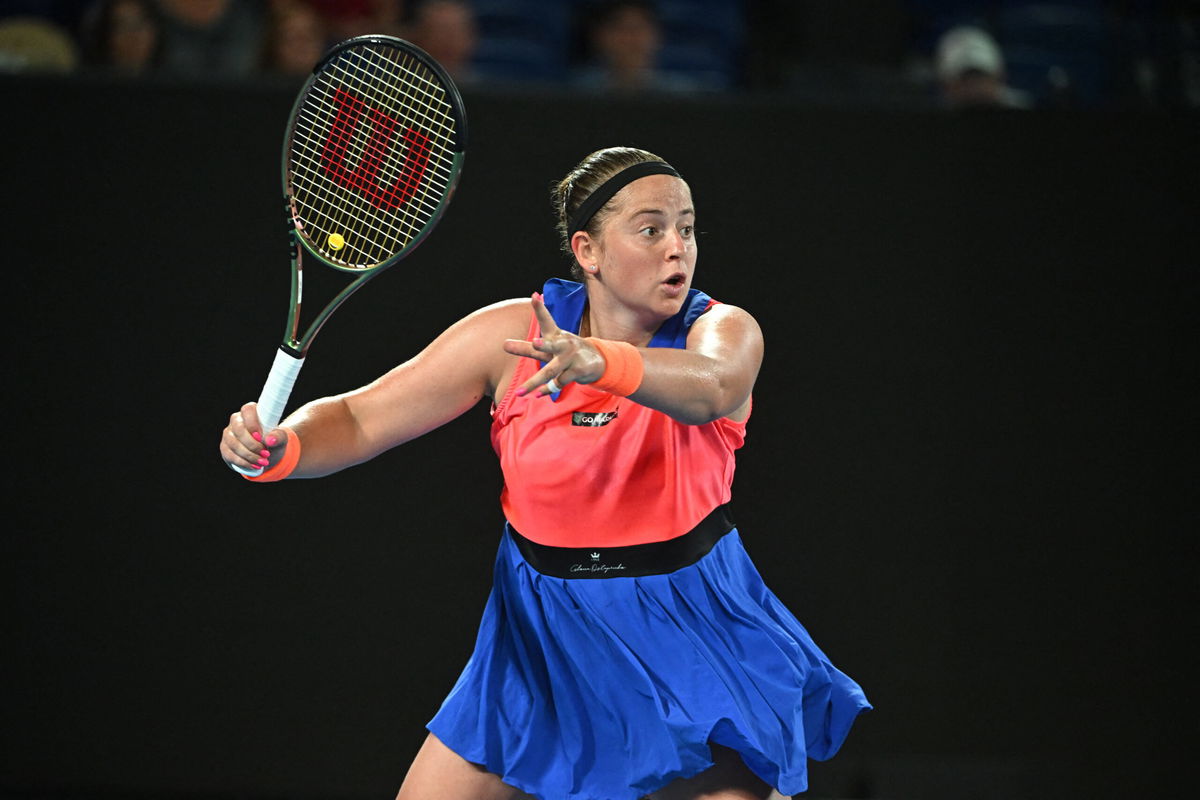
Facing the wrath of online trolls is an unfortunate occupational hazard for every professional tennis player. Still, when the toxicity crosses all bounds, it is difficult to cope with the abuse, as Jelena Ostapenko rightly pointed out. The former Major champion faced a vicious attack from online trolls after she had to retire in her match against Zhang Shuai in the second round of the National Bank Open.
Watch What’s Trending Now!
“Hopefully one of your family d13 in a tragic accident,” was a comment made by a fan which Ostapenko shared on her Instagram story. The Latvian also faced brutal body-shaming from fans, who criticized her for not being able to put up a fight against Zhang Shuai, who was much older than Ostapenko.
Deeply hurt by these abusive remarks, Ostapenko wrote: “This is what a professional athlete has to face after every loss.”
Ostapenko retired from the match against Zhang, while being 0-6, 0-4 down, with the Latvian clearly lacking her powerful baseline game. She was not physically fit and was struggling with major discomfort in her body, which is why she decided to withdraw from the match. Despite the obvious handicap, fans showed her no mercy, posting hurtful comments.
Ostapenko is not the only player who has received online abuse in recent times. At her pre-tournament press conference, Coco Gauff shared a unique way of handling online haters, saying she would respond if she received negative comments. She talked about taking the abuse in stride and not letting it affect her, and about tagging her online critics once she won her matches.
Disgruntled gamblers are the major source of abusive comments that tennis players receive, with people often blaming individual players for their financial losses.
Bettors Are the Biggest Source of Online Hate for Tennis Players
Online abuse against tennis players has been rising over the years, and the governing bodies in tennis, especially the WTA, have taken active measures to protect the players. In a unique digital measure, an AI-driven mechanism known as the Threat Matrix has been implemented, serving as a sieve that flags comments deemed abusive.
Using the Threat Matrix, it was determined that 40% of the abusive comments came from gamblers who had lost money when players lost their matches. Top players like Jessica Pegula had a strong opinion against the abuse from bettors, and while she welcomed the Threat Matrix initiative, she called for more change.
“Online abuse is unacceptable, and something that no player should have to endure. I welcome the work that the WTA and ITF are doing with Threat Matrix to identify and take action against the abusers, whose behavior is so often linked to gambling,” said Pegula last year. “But it’s not enough on its own. It’s time for the gambling industry and social media companies to tackle the problem at its source and act to protect everyone facing these threats.”
It’s not only the top players but also lower-ranked players who receive death threats from bettors, as Challenger and ITF tennis are lucrative betting grounds. Panna Udavardy faced a real-life threat this year before her Challenger match, with online users seemingly knowing her private information, such as her address and her family’s location. The Hungarian was given extra security during her match to ensure top-tier protection against potential mishaps.
With betting a legal activity and a billion-dollar industry, flagging every single threat from a disgruntled gambler might prove a huge hassle, but the use of the Threat Matrix shows initiative from the top tennis governing bodies.