
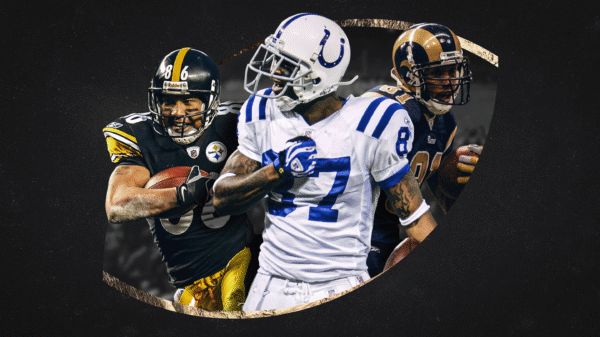
















The newest Hall of Fame class is set to be inducted, but for every celebratory moment of a player getting their gold jacket, there are countless players who came up just a bit too short. Every NFL fandom has players they think belong in the Hall of Fame. For some, it’s obvious who should be there. For others, you have to dig a little deeper. Here are the biggest Hall of Fame snubs for every NFL franchise.
Arizona Cardinals, RB Ottis Anderson
There’s probably a metaphor here about how the biggest snub in Cardinals history never played in Arizona and also had a couple of his biggest moments in New York, but that’s beside the point. Ottis Anderson was really, really good with the then-St. Louis Cardinals, and while his Hall of Fame case is a bit flimsy, the highlights should at least have him in the conversation. He came out of the gates fast with the Cardinals, winning Rookie of the Year after rushing for 1,605 yards and eight touchdowns in 1979, the first of his five 1,000-yard seasons with the franchise.
Anderson’s post-Cardinals career also bolstered his resume, as he won a pair of Super Bowls with the New York Giants. Notably, Anderson was the MVP of Super Bowl XXV, rushing for 102 yards and a touchdown in the 20-19 win over the Buffalo Bills. I suppose there could be some “which team would he be best known for” discussion that could lead to him not qualifying as the Cardinals pick here, but the vast majority of his regular-season production came with the team.
Atlanta Falcons, LB Tommy Nobis
The five-time Pro Bowl selection and 1967 AP First Team All-Pro pick spent 11 seasons with the Falcons, racking up 12 interceptions and 13 fumble recoveries across that span. You can make a strong argument that he was the best linebacker of the late 1960s, and yet, he passed away in 2017 without getting a spot in Canton.
Part of that was the lack of success for those Falcons team. Nobis played 133 NFL regular-season games, but he never appeared in a playoff contest. From 1966 to 1976, the Falcons finished above .500 twice. Nobis might have been a great player, but he was stuck on a bad football team and was never able to really breakthrough on the big stage. He was named to the Hall of Fame’s All-1960s team, but of the 17 defenders named to that team, Nobis is one of just four to not be enshrined in the Hall.
Baltimore Ravens, LB Terrell Suggs
You have to believe that Terrell Suggs is going to get into the Hall of Fame at some point, but so far, he’s 0-for-2 at making it into Canton despite being one of the most destructive defensive players of his era. A seven-time Pro Bowler, Suggs was the 2011 Defensive Player of the Year and is eighth in NFL history in sacks. His 202 tackles for loss are the most in NFL history, and he has a pair of Super Bowl rings, just for good measure.
The good news for Suggs: Based on where he finished in the 2026 voting, he’ll be an automatic finalist in 2027, so there’s another shot for him to get in. He was among the final seven players being considered on this most recent ballot, and with four of those players selected, 2027 could easily be the year he hears his name called. It just seems like something that could have happened on his first ballot in 2025.
Buffalo Bills, WR Steve Tasker
Steve Tasker’s receiving stats alone might not look Hall of Fame worthy, as he finished with 51 receptions for 779 and nine touchdowns. Not in, like, his best season or anything — that’s the numbers across his entire career. So, why would the former ninth-round pick, who didn’t have over 100 receiving yards in a season until his 11th year in the league, be worthy of this spot?
Because Tasker wasn’t just a receiver. He was also arguably the greatest special teams gunner of all time. A seven-time Pro Bowler, Tasker is a great example of how an impactful player can slip between the Hall of Fame cracks due to what the selection committee values. He blocked seven punts in his career and had 204 tackles on special teams. It’s a part of the game that goes overlooked most of the time, but Tasker is the best to ever do it and deserves to be in Canton.
Carolina Panthers, WR Steve Smith Sr.
If Steve Smith had played 20 years earlier, he’d be in the Hall of Fame, but he was active during one of the times that wide receiver play was at its zenith, which means he’s faced a lot of competition for a spot in the Hall of Fame.
The 2005 leader in receptions, receiving yards and receiving touchdowns, Smith made five Pro Bowl appearances and also won Comeback Player of the Year in 2005. His 14,731 career receiving yards rank eighth in NFL history, with everyone ahead of him already inducted. You would think that means Smith will get in at some point, but considering the glut of receivers waiting for their gold jacket, we’ll just have to wait and see.
Chicago Bears, C Jay Hilgenberg
For whatever reason, it’s really hard to make the Hall of Fame as a center. Since the turn of the century, just three centers — Dermontti Dawson, Mick Tingelhoff and Kevin Mawae — have been inducted. It’s tough for centers to really stand out, as they aren’t facing off against edge rushers and thus don’t really get the recognition of tackles.
But Jay Hilgenberg has a strong argument for a spot in Canton. A Pro Bowler every season from 1985 to 1991, Hilgenberg was an anchor for one of the best eras of Chicago Bears football. He was an elite run blocker and a crucial part of the team’s Super Bowl victory. Jason Kelce will likely be the next center inducted into the Hall, but Hilgenberg should be in there already.
Cincinnati Bengals, QB Ken Anderson
Ken Anderson’s issue is clear: He lacked postseason success, going 2-4 all-time in the playoffs, with both wins coming in 1981. If the Hall of Fame was determined solely off of regular season performance, he would have been a shoo-in, but the postseason matters too much, putting Anderson right on the edge, at the point where no one would be mad if he made it, but there hasn’t been a ton of momentum behind the possibility,
Anderson led the NFL in passing yards twice and completion percentage three times, and he posted the league’s lowest interception rate three times as well. He was the 1981 MVP and still ranks in the top 50 in career passing yards despite playing in an era where it was harder to move the ball through the air. When guys like Justin Herbert and Dak Prescott become Hall of Fame eligible, they’re going to look at Anderson not getting in yet and will feel rightly worried about their own chances. (Barring one of those quarterbacks getting a ring at some point, of course.)
Cleveland Browns, LB Clay Matthews Jr.
You could make a good argument that two people named Clay Matthews belong on this list, though Matthews Jr., the elder of the two, probably has the stronger case at the moment for being a snub.
The four-time Pro Bowler spent 19 seasons in the NFL, with 16 of those coming in Cleveland. His longevity is astounding, and it’s not like he was just puttering around by the end, as he had 6.5 sacks in his final NFL season with the Falcons in 1996. Overall, Matthews had 82.5 sacks and 24 forced fumbles during his long NFL career.
Dallas Cowboys, S Darren Woodson
How three-time All-Pro and five-time Pro Bowler Darren Woodson is still waiting on his gold jacket is a mystery to me. He spent 12 seasons with the Cowboys, winning three Super Bowl titles and leaving Dallas as the franchise’s all-time leader in tackles. He was a huge part of the team’s defense during those title years, but goes overlooked because so much of the credit for that success revolved around the offensive trio of Troy Aikman, Emmett Smith and Michael Irvin.
Woodson deserves strong consideration, though. Sure, his non-tackle numbers don’t jump off the page, but a big part of that was the role Dallas asked him to play. He’s also dealt with a very crowded field of contenders, especially at safety, with guys like Brian Dawkins, Ed Reed, John Lynch and Troy Polamalu all in over Woodson.
Denver Broncos, WR Rod Smith
Rod Smith is another victim of the whole “there were simply too many good wide receivers during the late 90s and early 2000s” issue. Add in that he started in the league a bit late after spending his first season on the practice squad and didn’t really garner a full-time role until 1997, and you can see why his overall numbers are a bit below Hall of Fame standards.
But Smith was really, really good. He posted eight 1,000-yard seasons and led the NFL in receptions in 113, and he was part of two Super Bowl-winning Broncos rosters. In the 2005 playoffs, Smith, nearing the end of his career, came up huge in a win over New England, catching six passes for 96 yards and a touchdown. If not for a hip injury that required a total hip replacement, he might have been able to add a couple more strong years at the tail end of his career that would have locked him into Canton.
Detroit Lions, WR Herman Moore
It can be a bit annoying to see someone say “why isn’t anyone talking about X player,” but I really mean it when I say it about Herman Moore, one of the best wide receivers of 1990s and, also, a player who I don’t hear anyone talk about these days. I mean, this is a player who, in 1995, was targeted 206 times, the second-most ever in a single season.
A four-time Pro Bowler and three-time First Team All-Pro, Moore’s peak probably lasted just a bit too short of a time for him to get Hall of Fame hype, as he had just four 1,000-yard seasons. Those were four incredible years, though. Moore also suffers from a lack of playoff success, as his team made it past the first round just once, though can’t blame him too much for that. In the 1995 NFC Wild Card Game, for example, Moore had seven catches for 133 yards and a touchdown, but the Lions gave up 58 points.
Green Bay Packers, WR Billy Howton
Oh look: another wide receiver! It really is the hardest position for a great player to rise above all the other great players and get that coveted Hall of Fame nod. One Packers wide receiver, Sterling Sharpe, was finally able to recently move from the snubbed receiver list into a Hall of Fame spot, but the same can’t be said for Billy Howton.
A four-time Pro Bowler during the 1950s, Howton led the NFL in receiving yards twice, and he was one of the earliest players to average over 100 receiving yards per game across a full season. Consistency was a concern, but it was a concern for most back in those days, right? The fact that someone who played that long ago still ranks among the top 100 players ever in both receiving yards and receiving touchdowns is as good an argument as any for his enshrinement in Canton.
Houston Texans, RB Arian Foster
Is Arian Foster going to ever get into the Hall of Fame? No. Does he deserve to be in Hall of Fame? Also no. Houston has only had two retired players who were Hall of Fame locks: Andre Johnson, who is in, and J.J. Watt, who isn’t eligible yet.
That’s not to say Foster wasn’t a good player, as he was named a Pro Bowler four times and led the NFL in rushing yards in his second NFL season, as well as leading the NFL in rushing touchdowns twice. Not bad for an undrafted player! The longevity just wasn’t there, though, as Foster played just eight NFL seasons, and only four of those were full campaigns. One of the biggest “what could have been” players of the 2010s.
Indianapolis Colts, WR Reggie Wayne
Marvin Harrison is in the Hall of Fame, but Peyton Manning’s other top receiver from his Indianapolis Colts tenure, Reggie Wayne, is still waiting to hear his name called. It’s a weight that continues because, well … wide receivers, y’all. There’s just so many of them with Hall of Fame cases that just keep coming up short.
Wayne made six Pro Bowls. He led the league in receiving yards once and had a total of eight 1,000-yard seasons. He ranks 31st in NFL history in receiving touchdowns and 10th in career receiving yards, with just one player ahead of him on the receiving yardage list still waiting to get into Canton. I really believe this is a “when, not if” situation, though he’s been eligible for seven years now and still hasn’t gotten in despite being a finalist each time, so maybe it’s time to start worrying about Wayne being a lifelong snub?
Jacksonville Jaguars, RB Fred Taylor
Maybe it’s because I’m in my mid-30s, but when I think about the Jacksonville Jaguars, I think about running back Fred Taylor. Those early 2000s Jaguars teams had one constant: Taylor, who was one of the NFL’s top running backs for a long period of time.
Will Taylor ever make it into the Hall of Fame? Probably not. He has just one Pro Bowl appearance to his name as well as only two seasons with double-digit rushing touchdowns. Still, he was a reliable piece for those early 2000s Jaguars, and he ranks in the top 50 all-time in rushing touchdowns. Maybe with a little more injury luck, Taylor has a strong-enough case to make it into Canton,
Kansas City Chiefs, WR Otis Taylor
Otis Taylor is in a weird spot, as much of his success came in the AFL, where he helped the Chiefs win a pair of titles. Still, he didn’t lose a step once the Chiefs moved to the NFL, leading the league in receiving yards in his second post-merger season in 1971.
Digging deeper into his AFL contributions, Taylor ranks seventh all-time in yards per game and third in yards per catch. If his career had begun slightly earlier, he might top the list of most receiving stats in that league, considering guys like Lance Alworth and Don Maynard had a few more seasons to put up their numbers before the league merged with the NFL after the 1969 season. Still, he ranks as one of the best Chiefs of all time, regardless of which league he posted most of his stats in.
Las Vegas Raiders, QB Jim Plunkett
It’s kind of surprising that a player who quarterbacked his team to two Super Bowl victories and won MVP in one of those trips isn’t already in the Hall of Fame. Though, it’s mostly because Jim Plunkett had one of the strangest regular-season careers ever.
Plunkett’s first stint in the NFL from 1971 to 1977 didn’t go super well. He never posted a winning record and was one of the league’s most turnover-prone quarterbacks, including two seasons with at least 22 interceptions. He didn’t play at all in 1978 after landing with the Raiders, where he served as a backup for two seasons before taking over as the starter in 1980. From there, his career got weird, with Plunkett in and out of the starting lineup through his time with the franchise. But, come on: weirdness is cool! Plunkett’s journey, as well as the heights he reached, should have given him a real chance at Canton.
Los Angeles Chargers, DE Leslie O’Neal
Leslie O’Neal took the league by storm as a rookie in 1986, picking off two passes, including returning one for a touchdown, and adding five forced fumbles and 12.5 sacks. Unfortunately, he missed all of 1987 and half of 1988 with a knee injury, taking away more chances for him to pile up stats. He was still really good once he was healthy in 1989, making the first of six Pro Bowls, but that brief little interruption in his career probably cost him a Hall of Fame shot.
Still, a great career overall for O’Neal, who ranks in the top 50 in career forced fumbles and is officially 15th all-time in sacks (or 21st since 1960 if we include unofficial numbers). It’s strange that a player this productive isn’t in Canton. Will we ever see that change?
Los Angeles Rams, WR Torry Holt
Surprise, surprise: another receiver from the same era as so many of the other receivers on this list. But even amongst those players, Torry Holt stands out as someone whose exclusion doesn’t make a ton of sense.
The only real knock against Holt is longevity, as he only played 11 seasons in the NFL. But those were 11 very good seasons, with Holt leading the league in receiving yards twice and posting eight consecutive 1,000-yard campaigns. A seven-time Pro Bowler and a Super Bowl champion, Holt has a Hall of Fame resume. He just hasn’t gotten a gold jacket yet. It almost has to be because he didn’t stick around for a few more years, but he still shsould be in, considering he’s top 50 all-time in receiving touchdowns and 10th in receiving yards per game.
Miami Dolphins, G Bob Kuechenberg
One of the better guards of his generation, Bob Kuechenberg has consistently been passed over for Hall of Fame induction, despite a strong resume that should at least have him in the conversation, with Kuechenberg making six Pro Bowls and winning two Super Bowl rings with the Dolphins during his 14-year career.
Could off-field things be impacting that? Kuechenberg had a tendency to be critical in his post-playing career, and it’s possible that could have negatively impacted Hall of Fame voters. Even then, one of the best guards from one of the best teams of the late 1970s should probably have garnered a lot more Hall of Fame hype than he actually received.
Minnesota Vikings, DE Jim Marshall
Jim Marshall only made the Pro Bowl twice, which might give you some pause when assessing his candidacy. Look beyond that, though, and you find a player who was at the top of his game for a long, long time, as Marshall spent 20 seasons in the NFL, with 19 of those in Minnesota. He was still a full-time starter by the time his final season rolled around.
That longvity allowed Marshall to unofficially record 129.5 sacks, 26th-most of all time. He also ranks 22nd all time in games played. A key member of the famed Purple People Eaters, Marshall ranked only behind Carl Eller for sacks amongst that unit.
New England Patriots, HC Bill Belichick
That’s right: New England’s biggest snub is a head coach, not a player. But when that head coach is Bill Belichick, arguably the greatest head coach in NFL history, and he doesn’t get in in his first year of eligibility, what else are you going to call it? Sure, if I were writing this article a year from now, Belichick probably wouldn’t be the answer because there’s no way he gets passed over twice, but someone with Belichick’s resume should never have even been passed over once.
We’re talking about a head coach with an NFL-record six Super Bowl rings. A three-time NFL Coach of the Year. He has the most playoff wins of any head coach and the most divisional championships of any as well. Belichick not getting in on the firsst ballot was a huge, huge snub.
New Orleans Saints, LB Pat Swilling
Pat Swilling is a great example of an edge rusher who just misses out on the cut line for the Hall of Fame. He made five consecutive Pro Bowl appearances from 1989 to 1993 and led the NFL in sacks during the 1991 season, but a drop in production once he left New Orleans just doesn’t give him quite the resume needed for induction.
Still, a strong resume for the Hall of Very, Very Good, as Swilling was the 1991 Defensive Player of the Year and ranks 12th in league history in forced fumbles, as well as in the top 50 in career sacks. Some postseason success might have boosted his resume enough to make it in, but his teams went 0-6 in the playoffs and he recorded just a single postseason sack.
New York Giants, QB Eli Manning
Eli Manning’s Hall of Fame candidacy has always been a thing of contention. It boils down to this: Do you value longevity and two Super Bowl rings more than you value sustained strong play? Because yes, Manning is a two-time Super Bowl MVP and stopped the Patriots from achieving a perfect season, but you can also argue that his regular season stats, as well as his lack of playoff success outside of the Super Bowl years — literally zero playoff wins in all of his other playoff appearances, and just two total playoff appearances after 2008 — make him unworthy of inclusion.
Manning’s biggest knock is his struggles with interceptions, as he led the league in picks three times. He’s 12th all-time in most interceptions thrown, though he also ranks 11th in both touchdowns and passing yards as a kind of counter to that. Manning will very likely get in at some point, but the discussion surrounding him is a microcosm of what an individual cares most about when evaluating a player’s career.
New York Jets, DE Mark Gastineau
Five-time Pro Bowler Mark Gastineau was a three-time First Team All-Pro, but his Hall of Fame case took a major hit after he played just 10 seasons in the league. From 1981 to 1985, though? Gastineau was one of the league’s elite defensive ends.
That includes Gastineau leading the NFL in sacks in both 1983 and 1984, making him the first player since Deacon Jones in 1968 and 1969 to do so, Since then, the only players to lead the league in sacks in back-to-back years were Reggie White and T.J. Watt. That’s extremely good company to be in.
Philadelphia Eagles, OL/DL Al Wistert
We’re going way, way back here, all the way to the 1940s, with a player who was one of the NFL’s early stars. Al Wistert, who played on both sides of the ball for the Eagles, was a four-time first-team All-Pro selection and was part of two NFL championship teams during his tenure with the Eagles.
Unfortunately, Wistert played just nine seasons in the NFL, appearing in only 95 total games. Despite being a key piece of some very good Eagles teams — and playing his first season for the combined Steelers/Eagles franchise, one of the oddities of the World War II era NFL — Wistert never got the nod for Canton, and considering how long ago his NFL career was, we can likely conclude that he never will.
Pittsburgh Steelers, WR Hines Ward
We have come to the final entry amongst the long line of 2000s-era wide receivers who haven’t gotten their deserved Hall of Fame nod: Pittsburgh Steelers wide receiver Hines Ward, who spent 14 seasons in the NFL and made four Pro Bowl appearances.
Ward never led the NFL in any receiving categories nor did he make a First Team All-Pro list, but he does have a Super Bowl MVP award to his name, and his 85 career touchdowns rank 19th in NFL history. Basically every retired player ahead of him on the list is either in the Hall of Fame or soon will be aside from potentially Jimmy Graham.
San Francisco 49ers, RB Frank Gore
For years, running back Roger Craig was the answer here, as he continued to be snubbed, despite his strong resume. That finally changed in 2026, ending one of the biggest Hall of Fame snubs we’d seen. Now, the title goes to another star running back from the franchise: Frank Gore. (Funnily enough, 2026 was Gore’s first year of eligibility, the same year that Craig inducted.)
Gore played in the NFL for 16 seasons, with the first 10 of those coming in San Francisco. A devastating knee injury in college put his NFL career in doubt early, but he was able to recover and went on to rush for 16,000 yards. That’s the third-most of all time, behind only Hall of Famers Emmitt Smith and Walter Payton.
Seattle Seahawks, RB Shaun Alexander
Shaun Alexander is another example of a player who just needed to be in the league a little bit longer to bolster his Hall of Fame candidacy, as he spent just nine seasons in the NFL, and his final one in Washington barely counts, as he had just 11 carries in 2008.
But Alexander also had one of the best seasons ever for a running back with his monster 2005 campaign. That year, Alexander rushed the ball 370 times for 1,880 yards and 27 touchdowns, all the best marks of any player that season. In fact, the 27 rushing touchdowns tied the NFL record. Could his heavy workload that season have contributed to the shortness of his career? For sure, but that season alone is in the pantheon of great NFL campaigns.
Tampa Bay Buccaneers, DE Simeon Rice
Buccaneers defensive end Simeon Rice is one of the best fumble forcerers we’ve seen in the NFL, forcing 37 of them in his career, including four seasons with six or more. He ranks 16th in league history in forced fumbles, and since sacks became an official stat in 1982, he ranks 23rd in that stat.
In addition to those numbers, Rice was a three-time Pro Bowler and a key part of Tampa’s Super Bowl team. He might never have been the league’s best defensive end, but he was among the better ones during the late 1990s and early 2000s, and future induction into the Hall of Fame wouldn’t be a shock at all.
Tennessee Titans, RB Eddie George
Eddie George was a model of consistency for the Tennessee Titans, rushing for at least 900 yards in each of his eight seasons with the team. Unfortunately, George’s career was cut short after he went to Dallas and was unable to make much of an impact, and he was unable to find another home beyond that.
Here we have, once again, the issue of longevity. Running back is a position where a short career can be forgiven more than it is at other positions, but a nine-year career is short for someone hoping to make the Hall fo Fame, even if George is a four-time Pro Bowler who ranks 29th in career rushing yards despite his relatively short time in the NFL.
Washington Commanders, OT Joe Jacoby
Back in the 1980s, Washington had one of the best offensive lines not just of that era, but of all time. The “Hogs,” as they were called, helped the team win three Super Bowls, but only one player from that line, Russ Grimm, has so far been inducted into the Hall of Fame.
Jacoby has long deserved a spot as well. A four-time Pro Bowl selection and two-time First Team All-Pro, Jacoby was selected for the Hall of Fame’s All-1980s team. He is one of just two offensive players from that team to not be in the Hall of Fame already. Jacoby’s career successes make him one of the most glaring omissions from Canton.
 Add us as a preferred source on Google
