









We’re going to look at an EPA-based metric to see how today’s NFL QBs hold up under an advanced stats microscope, and to do that, we turn to ESPN’s Total QBR.
Why not simply use the better-known passer rating? Because the trusty NFL passer rating was designed to evaluate the passing game only. It does not account for a quarterback’s running game, his ability to generate first downs, the amount of sacks he takes, penalties, success rate, and many other things.
ESPN’s QBR is an attempt to fix some of the weaknesses of the traditional passer rating. ESPN’s Sharon Katz and Brian Burke explain the concept:
Traditional box score stats distort the performances […] because they (1) fail to account for all of the ways a quarterback can affect a game, (2) don’t put plays into the proper context (a 5-yard gain on second-and-5 is very different from a 5-yard gain on third-and-10), and 3) don’t acknowledge that a quarterback has teammates who affect each play and should also get credit for everything that happens on the field.
Total QBR, much like the Expected Points concept, looks at every single play, adds context (e.g. down-and-distance, score differential, win probability etc.) and then allocates credit to the quarterback and his teammates to produce a clearer measure of quarterback efficiency. Uniquely to ESPN’s Total QBR, the resulting metric is expressed as a number on a 0-to-100 scale to produce a player’s Total QBR.
An average quarterback will have a QBR around 50, and a Pro Bowl-level player will have a QBR around 75 for the season. On a game level, however, a QBR of 75 means that holding all other factors constant (defense, offensive teammates, etc.), a quarterback’s team would be expected to win about 75 percent of time, given that level of QB play.
In the tables further down this post is a look at 45 active NFL quarterbacks (plus Tom Brady, Drew Brees, and Eli Manning, for reasons that will become clear later) and the games they started between 2015 and 2025. In games in which those 45 QBs started, had at least 10 pass attempts, and posted a QBR of 75 or higher, they are a combined 717-164-2 for a win percentage of .812, which is not far from the 75 percent ESPN talks about above.
If we accept that a Total QBR of 75 or more denotes a good game by the QB, it follows that a QB with a lot of 75+ QBR games is a good quarterback.
But instead of simply summing up the number of good games for each quarterback, we’ll use “Good game percentage” (games with a Total QBR above 75 as a percentage of total games started) as our metric of choice. This accounts for the fact that the quarterbacks in this analysis have played a different number of games over the last 11 seasons. Matthew Stafford for example has played 161 games over that span, while Brock Purdy has only 45. Looking at “good game percentage” corrects for that.
Also, why the seemingly arbitrary cutoff in 2015? Because that’s the year the average passer rating (not QBR) hit 90 for the first time after steadily climbing from the 70s in the early 200s. Scheme changes, rule changes, and better quarterback protection lead to that steady increase, and 2015 marked the transition into a new era where the passer rating has consistently oscillated around 90.0, as you can see from the graph below.

And with all that out of the way, here’s a look at the 36 NFL QBs with at least 20 starts since 2015 along with their “good game percentage”. We’ll look at the QBs with fewer than 20 starts a little further down this post.
The table is color coded into tiers to improve legibility, and I’ll expand on those tiers after the table. The presumptive backups (per the latest ourlads.com depth charts) are marked in italics.
| Tier | QBs with 20+ starts | 2026 Team |
Games Started (min 10 PA) |
“Good Games” (QBR> 75) |
Good game percentage |
| Tier 1: Planet Mahomes | Mahomes 17-22 | KC | 79 | 41 | 51.9% |
| Brock Purdy | SF | 45 | 22 | 48.9% | |
| Jordan Love | GB | 48 | 22 | 45.8% | |
| Patrick Mahomes 17-25 | KC | 126 | 57 | 45.2% | |
| Tier 2: Borderline Top 5 | Drew Brees (ret.) | — | 84 | 36 | 42.9% |
| Josh Allen | BUF | 124 | 50 | 40.3% | |
| Tom Brady (ret.) | — | 126 | 49 | 38.9% | |
| Dak Prescott | DAL | 138 | 53 | 38.4% | |
| Lamar Jackson | BAL | 105 | 39 | 37.1% | |
| Justin Herbert | LAC | 95 | 34 | 35.8% | |
| Tier 3: Above average | Drake Maye | NE | 27 | 9 | 33.3% |
| Matthew Stafford | LAR | 161 | 49 | 30.4% | |
| Joe Burrow | CIN | 77 | 23 | 29.9% | |
| Deshaun Watson | CLE | 71 | 20 | 28.2% | |
| Aaron Rodgers | PIT | 151 | 42 | 27.8% | |
| Kirk Cousins | LV | 158 | 44 | 27.8% | |
| Jared Goff | DET | 151 | 40 | 26.5% | |
| Jayden Daniels | WAS | 23 | 6 | 26.1% | |
| Jameis Winston | NYG | 89 | 23 | 25.8% | |
| Baker Mayfield | TB | 120 | 31 | 25.8% | |
| Jalen Hurts | PHI | 78 | 20 | 25.6% | |
| Tier 4: The bus drivers | Tua Tagovailoa | ATL | 65 | 16 | 24.6% |
| Kyler Murray | MIN | 86 | 21 | 24.4% | |
| Daniel Jones | IND | 80 | 19 | 23.8% | |
| Bo Nix | DEN | 34 | 8 | 23.5% | |
| Sam Darnold | SEA | 90 | 20 | 22.2% | |
| Marcus Mariota | WAS | 83 | 17 | 20.5% | |
| Trevor Lawrence | JAX | 60 | 11 | 18.3% | |
| Tier 5: The Eli Manning pit of endless misery |
Eli Manning (ret.) | — | 67 | 12 | 17.9% |
| CJ Stroud | HOU | 45 | 8 | 17.8% | |
| Geno Smith | NYJ | 68 | 11 | 16.2% | |
| Andy Dalton | PHI | 104 | 16 | 15.4% | |
| Caleb Williams | CHI | 34 | 5 | 14.7% | |
| Joe Flacco | CIN | 89 | 13 | 14.6% | |
| Mac Jones | SF | 55 | 8 | 14.5% | |
| Bryce Young | CAR | 44 | 6 | 13.6% | |
| Jacoby Brissett | ARI | 64 | 8 | 12.5% |
Tier 1: Planet Mahomes
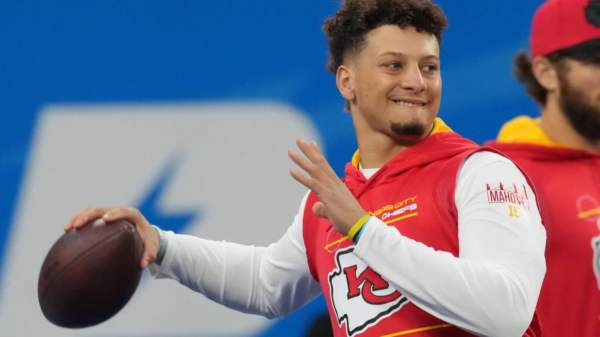
For a long time, Patrick Mahomes was a planet unto himself. Over a span of five years (2028 -2022), every second game he played was a>75 QBR game. And even if he wasn’t able to maintain a good game percentage above 50%, since, he still stands tall above almost all other QBs on this list.
To understand how his career has progressed, here’s an overview of how his good game percentage has developed over the years. Mahomes only started one game in his 2017 rookie season so I’m bundling that game into the 2018 numbers in the little table below.
| Patrick Mahomes | 2017-18 | 2019 | 2020 | 2021 | 2022 | 2023 | 2024 | 2025 |
| Games Started | 17 | 14 | 15 | 17 | 17 | 16 | 16 | 14 |
| >75 QBR | 9 | 7 | 9 | 8 | 8 | 5 | 5 | 6 |
| Good game percentage | 52.9% | 50.0% | 60.0% | 47.1% | 47.1% | 31.3% | 31.3% | 42.9% |
Mahomes entered the league on a blistering pace, and his play only dropped off in 2023 and 2024 before picking up again in 2025. How his Achilles injury will affect his numbers going forward is anybody’s guess, though the Chiefs were willing to bet half a billion dollars over the next eight years that things will work out.
Circling Planet Mahomes are Brock Purdy and Jordan Love, even if both are still early in their careers with 45 and 48 starts respectively. After 46 games (2017-2020) Mahomes was sporting a 54.3 good game percentage, so both Purdy and Love are off that blistering pace, and it remains to be seen whether they can maintain their high percentage over time, or if they’ll move down a tier. Still, the 49ers and Packers will likely dominate this decade with these two quarterbacks.
Tier 2: Borderline Top 5
Drew Brees and Tom Brady are both HOF-bound and highlight this tier, which I’m only calling “Borderline Top 5” because calling it the “Elite Tier” would likely ruffle a lot of feathers. Either way, Brady and Brees are easily two of the best QBs over the last two decades and are surely deserving of the word “elite”, in large part because they’ve sustained elite performance over almost two decades, something the other players in this tier haven’t really managed yet. Dak Prescott is a case in point. Even if his good game percentage is almost identical to Brady’s, he’s had a much more up-and-down performance than Mahomes for example.
| Dak Prescott | 2016 | 2017 | 2018 | 2019 | 2020 | 2021 | 2022 | 2023 | 2024 | 2025 |
| Games Started | 16 | 16 | 16 | 16 | 5 | 16 | 12 | 17 | 8 | 17 |
| >75 QBR | 9 | 6 | 3 | 7 | 2 | 6 | 5 | 8 | 0 | 7 |
| Good game percentage | 56.3% | 37.5% | 18.8% | 43.8% | 40.0% | 37.5% | 41.7% | 47.1% | 0.0% | 41.2% |
Coincidence or not, but the number of Super Bowl rings between the active players in this tier (Josh Allen, Dak Prescott, Lamar Jackson, Justin Herbert) is exactly zero, and perhaps that’s why we can’t yet call this tier the Elite tier.
But also noteworthy about this quartet of players: they’re all still with their original teams. No other QB with 100 or more starts on this entire list is still with the team that originally drafted him.
Tier 3: Above average
This third tier includes QBs that have an above average good game percentage (the 45 QB average is 25.0%). You might find some names here that leave you scratching your head. Is Aaron Rodgers really “just” an above average QB? Remember, this is only about data since 2015, and you could easily argue that this is unfair for someone like Rodgers, who may have been the original Planet Mahomes for a while: From 2008-2014, Rodgers was cruising at a 45.6% “good game percentage”, which would rank him third overall in the list above. But Rodgers hit a slump from 2015-2019 with a percentage of just 28.2%, rebounded in 2020 & 2021 (56.3%) before nose-diving towards the end of his career (2022-2025: 7.8%). For large parts of his career, Rodgers was right up there at the top of the list, but this sample gives him an unfavorable look; such are the vagaries of arbitrary cut-off points in statistics, and such are the risks of extending a career that has run its course.
Tier 4: The bus drivers
This tier contains a bunch of below-average QBs that have a progressively worse good-game percentages. For younger guys like Bo Nix, there at least remains the hope that he can still move up the ranks. For teams banking on their veteran QB’s ability to move up the ranks, that’s highly unlikely to happen. If an NFL QB doesn’t put it together in his first four years as a starter, he never will.
Tier 5: The Eli Manning pit of endless misery
This final tier is made up mostly of QBs whose name recognition or draft pedigree has kept them in the league much longer than they should have been. If these guys were called Ben DiNucci (UDFA) they’d be looking for a job as a backup QB in the indoor football league. But alas, hope springs eternal for a highly-drafted underperformer with name recognition.
On to the mostly younger QBs with less than 20 starts. I felt that the small sample size could possibly distort the overall picture, which is why I’m listing them separately.
| Player | 2026 Team | Games Started (min 10 PA) |
“Good Games” (QBR>75) |
Good game percentage |
| Malik Willis | MIA | 6 | 3 | 50.0% |
| Michael Penix | ATL | 12 | 4 | 33.3% |
| J.J. McCarthy | MIN | 10 | 2 | 20.0% |
| Jaxson Dart | NYG | 12 | 2 | 16.7% |
| Tyler Shough | NO | 9 | 1 | 11.1% |
| Cam Ward | TEN | 16 | 1 | 6.3% |
| Will Levis | TEN | 19 | 0 | 0.0% |
| Sam Howell | DAL | 18 | 0 | 0.0% |
| Shedeur Sanders | CLE | 7 | 0 | 0.0% |
Sticking to the logic of the tiers we used above, Malik Willis, now the starter in Miami, is the clear standout here, but are six starts over four years enough to draw any type of conclusion from? Michael Penix looks like he’s off to an okay start. But can he keep it up in his second year and hold off backup Tua Tagovailoa?
That starting job is something JJ McCarthy has already lost in Minnesota after one year. The team hasn’t made an official announcement yet, but Kyler Murray is taking that job without even breaking a sweat. And is anybody really betting on Shedeur Sanders getting the Browns starting job? Jersey sales may be the only thing keeping this an ‘open competition’ in Cleveland.
For the Cowboys, there is good and bad news in all of this:
- Jaxson Dart in New York is nothing more than a Daniel Jones clone, who himself is nothing more than an Eli Manning clone impersonating an NFL-quality starter. Famous Jameis may offer more upside than Dart, who is one failure to slide away from IR.
- In Washington, the Commanders will have to hope Jayden Daniels finds back to his 2024 form (35.3%) and doesn’t pick up where he left off in 2025 (0%). And Mariota is no upgrade at this point in his career.
- In Philly, a barely above-average QB who can’t throw over the middle is being propped up by a strong supporting cast, but he’s not going to win you a lot of games on his own.
- The Cowboys on the other hand have a backup in Sam Howell who hasn’t had a 75+ QBR game in 18 starts, and Joe Milton’s two starts didn’t yield any such game either. It’s Dak or bust in Dallas.
Ultimately, it’s not one player that wins and loses games. What the numbers indicate is that some QBs get a lot more help from their teams when they have a good game than others do, a reflection of the fact that it’s not one player who wins and loses games.
Dak Prescott has more than his fair share of detractors, and even more so among Cowboys fans it seems. But if you judge a QB by the statistical company he keeps, Dak Prescott is at the very top of the game.
“So,” some might say, “Dak has had some good games. But my eye test tells me he’s had a lot of bad games. Why are we not looking at those?”
Those voices may or may not have a point. Because if you want to be a top QB in this league, it’s not enough to have a bunch of 75+ QBR games that give your team a good chance to win. It’s at least equally important to minimize the number of bad games in which QBs actively lose games for their teams. And that’s something we’ll look at in the next post, where we look at “bad game percentage” and may find some surprises there as well.
