


































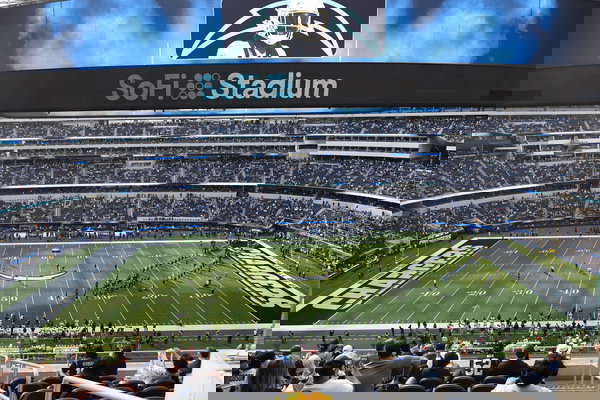
When the USMNT stepped onto the field for its World Cup opener at SoFi Stadium, the surface beneath them looked a little different. The stadium that normally hosts the Los Angeles Rams and Chargers had swapped its artificial turf for natural grass to meet FIFA’s World Cup requirements. Watching from afar, San Francisco 49ers tight end George Kittle noticed. His reaction was brief, but it tapped into a debate NFL players have been having for years.
Watch What’s Trending Now!
“Also, this grass looks great on Sofi’s field… wonder if we could get that all season,” George Kittle mused on X.
When the USMNT ran out for their World Cup opener at SoFi Stadium in Inglewood, California, they played on newly installed natural grass. SoFi is normally home to the Los Angeles Rams and Chargers, two NFL teams whose players have been grinding on artificial turf season after season.
FIFA looked at that same surface and said no. The organization mandated that all 16 World Cup host stadiums across the United States, Mexico, and Canada install natural grass, full stop. No exceptions, no shortcuts.
The conversion extended well beyond Southern California. Seven NFL venues that normally use artificial turf temporarily switched to grass for the tournament, including MetLife Stadium, AT&T Stadium, Gillette Stadium, Lumen Field, NRG Stadium, and Mercedes-Benz Stadium. At SoFi, the transformation was impossible to miss, with the field replaced, branding altered throughout the venue, and parts of the stadium reconfigured to meet FIFA’s tournament standards.
NFL players watched all of this unfold and felt something they could not quite shake. Jermaine Eluemunor, an offensive lineman for the New York Giants going into his tenth NFL season, said what a lot of players were thinking.
“I can say wholeheartedly that grass feels way better than turf,” Eluemunor said, per Rohan Nadkarni of NBC News. “With MetLife getting grass, obviously it’s cool for FIFA and the World Cup. It’s one of the biggest stages in the world, but, at the same time, the NFL as a whole is one of the most profitable businesses in the world, and so you would think that we as players would have a say in the fields that we get to play on.”
NFLPA executive director JC Tretter has made a similar case. Speaking on Cam Heyward’s “Not Just Football” podcast, Tretter pointed to player feedback gathered by the union and said the preference goes beyond aesthetics.
“There is something about the feeling of being on grass, the body feels different,” Tretter said. “I think if you ask the coaches, just standing on grass vs. standing on turf for three hours feels different. There is something there that impacts the body.”
An NFLPA survey of over 1,700 players found that 92% preferred grass over turf. The figure has become one of the union’s most frequently cited data points, with both Tretter and current NFLPA executive director Lloyd Howell pointing to it as evidence of how strongly players feel about playing surfaces.
Imago
However, NFL Commissioner Roger Goodell tried to paint a different picture back in 2023.
“You have other players who like playing on the turf field, because it’s faster,” Goodell said. “So you’ve got mixed opinions. What we want to go on is science, we want to go on what’s the best from an injury standpoint.”
The injury research lines up with how players feel, too. During the 2022 NFL season, more non-contact injuries occurred on turf than on grass. A study by the American Orthopedic Society for Sports Medicine found that playing on turf raises the risk of lower-body injuries by 16% and non-contact injuries by 20%. NFLPA president JC Tretter was direct about it.
“Grass is a significantly safer surface than turf,” he said.
The union has continued to draw attention to the issue whenever major soccer tournaments arrive at NFL venues. Ahead of the FIFA Club World Cup in 2025, the NFLPA’s official account reacted to video of a grass field being installed at MetLife Stadium with a short but pointed message: “Looks nice 🧐… #SaferFields.”
The pushback from turf supporters is that newer synthetic surfaces make older injury studies outdated. Anyways, players who have spent years on both surfaces are not convinced.
FIFA figured it out across 16 stadiums in three different countries, ten of which needed cool-season grass blends of Kentucky bluegrass and perennial ryegrass. and six requiring warm-season hybrid Bermuda.
John Trey Rogers, a turfgrass professor at Michigan State who was part of the team that helped engineer the World Cup playing surfaces, acknowledged that switching to grass league-wide would not be simple. Concerts, unpredictable weather, and busy stadium schedules all make natural grass harder to maintain.
“It would take quite a commitment,” he said. But he also made clear that with the right investment, it is entirely doable.
The discussion is unlikely to fade anytime soon. The NFL’s current collective bargaining agreement runs through 2031, and Tretter has already indicated that field surfaces will remain part of future conversations between the league and the players’ union.
For now, FIFA’s World Cup requirements have provided players with a visible example of something many of them have been advocating for all along. As stadiums temporarily trade turf for grass on soccer’s biggest stage, NFL players continue to ask whether those same conditions could eventually become permanent during football season.
